
On the first Thursday in September, several hundred people gathered outside Holyrood carrying banners against AI data centres. They had come from around fifteen local campaigns, Larbert to the Borders, Fife to Inverclyde, and their message to John Swinney was blunt: stop approving these things until there is a strategy, and until then, listen to the communities already saying no. Larbert alone has drawn 7,000 objections. Auchtertool’s proposed Cato development, at 600 megawatts reportedly the second-largest data centre on earth, would sit inside a Fife village smaller than the campus itself. In the Borders, the Duke of Roxburghe has been offered a private briefing with every Scottish Borders councillor to make the case for his own £2 billion scheme on the Roxburghe Estate, a meeting leaked emails describe the council’s own chief executive arranging and encouraging planning committee members to attend, against a petition that has by now passed 22,000 signatures. Edinburgh’s council has already thrown one scheme out, at the former RBS headquarters, for failing to show its green credentials. The Scottish Greens tried to force a moratorium at First Minister’s Questions before summer recess. The SNP’s own National Council backed one too. The government has said no to all of it so far.
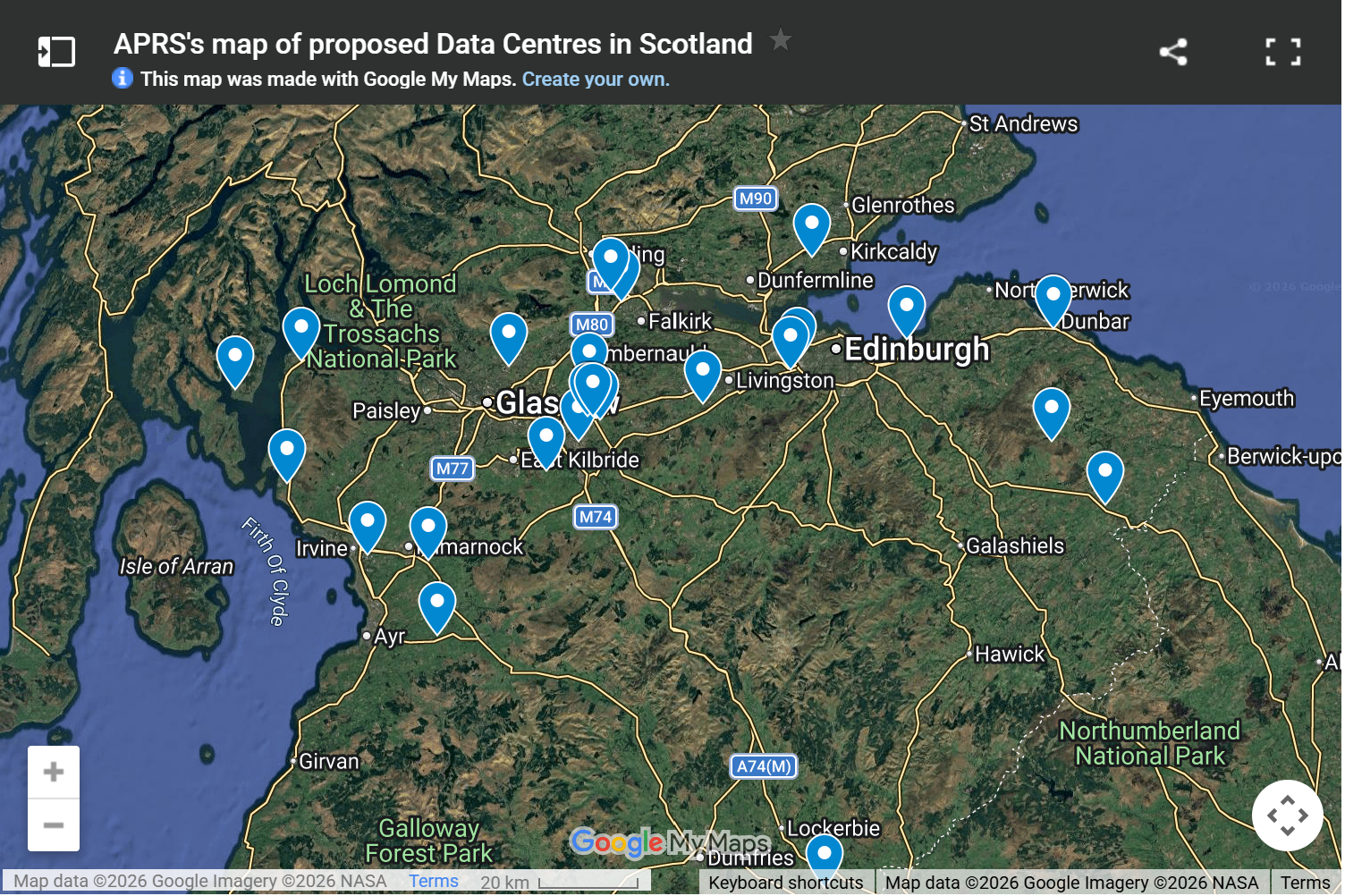
Every one of those campaigns is right to fight the site in front of it. Police Scotland has already warned it may need what it calls “robust security” if the Larbert scheme goes ahead over local objection, which is itself a measure of how far this has travelled from an ordinary planning dispute. The Larbert site would put 200 diesel backup generators within 50 metres of a 56-bed hospice for the terminally ill and within 400 metres of Forth Valley Royal, an 860-bed hospital. Action to Protect Rural Scotland, the charity that has done most to knit these fifteen-odd local groups into something resembling a national campaign, now publishes an interactive map of every hyperscale proposal in the country, precisely so that a resident in Cockenzie or Dunbar or Bishopbriggs can see they are not fighting alone. What none of them can do alone is answer the question underneath all twenty-four proposals now in the planning system, which together would draw over 150 per cent of Scotland’s peak demand: why is this landing in the Central Belt and the Borders at all, when Scotland spends hundreds of millions of pounds a year paying wind farms further north to switch off?
The Duke’s own developers, to their credit, say the quiet part out loud. Their pitch for the Roxburghe scheme argues the site can help prevent some fifty million pounds a year of wasted wind energy, because it sits near turbines the grid regularly switches off. That is the correct diagnosis wearing the wrong politics. The waste is real. The fifty million pounds it could capture should not become one aristocrat’s private return on a family estate that already runs to fifty thousand acres, a castle, a golf course and a hotel.
Start with the waste, because the waste is the argument. Generators in Scotland’s congested transmission zones, principally the B4 and B6 boundaries in NESO’s own terminology, are routinely told to reduce output, and the system pays for both sides of that decision: for the generation turned down, and for the gas fired up elsewhere to replace it. NESO recorded £1.7 billion in thermal constraint costs for 2024/25, up 64 per cent on the year before. Widen it to every category of constraint and the total climbs to £1.9 billion, 71 per cent of Great Britain’s whole balancing bill. Gas dominates the replacement side: £959 million in gas offer costs in winter 2024/25 alone, much of it covering exactly the shortfall Scottish constraints create. This is not a technical footnote. It is public money spent unmaking electricity that has already been produced, on a scale NESO expects to keep climbing toward £8 billion a year by 2030.
The obvious answer is more pylons, and National Grid is building them, slowly, at a pace that would make a Bolshevik weep. But that’s not quite right either. Electricity is expensive and contested to move over long distances. Data is not. So don’t move the electrons south to the compute. Move the compute north to the electrons.
Britain has done something like this before, once, in Manchester. The National Computing Centre opened on Oxford Road in 1966, one of the visible products of Wilson’s ‘white heat’ of scientific revolution, built to put scarce computing time within reach of industry when computers themselves were the bottleneck. By the 1980s that scarcity had gone, so the state let the Centre wither into a membership body and then sold its commercial arm into what is now NCC Group, a cybersecurity firm on the FTSE 250. The lesson is not the technology. It is that the state built serious public computing infrastructure once, and handed it to the market the moment the scarcity that justified it moved somewhere else.
Scarcity has moved on again, from silicon to electricity, and the shape of the answer is a national compute utility: not a single site but a grid of publicly owned compute campuses, sited where curtailed renewable power already sits. That is not official policy. It is an idea some policy people are starting to float, quietly, in the places where the mismatch between generation and demand is worst, and it is worth noticing that the people floating it are not, on the whole, socialists.
Which is where the moratorium campaign meets its harder question. Every one of the twenty-four sites now working through Scottish planning, Cato in Fife, Rufus in East Ayrshire, Aurelius in North Lanarkshire’s new AI Growth Zone, the schemes at Larbert, Hermiston and the Gyle, sits in or near the Central Belt because that is where the fibre, the grid connections and the skills base already are. None of it is sited to relieve a single constraint. A properly sited national grid of compute campuses would look nothing like this map. It would sit north of the Central Belt, on the curtailed capacity these very same communities’ wind farms are already producing and being paid to switch off, and it would be owned publicly, not by ILI Group or whoever comes after them.
That is a harder demand than a moratorium, because a moratorium only has to say no. A compute utility has to say what compute is for, who owns it, and where the profit that a hyperscaler or a duke currently extracts from a stranded grid connection would go instead. Public ownership of the racks means nothing if the models running on them are still licensed from the same handful of firms that own the training data and the chips. Nationalising the plug socket while leaving the extraction in place is exactly what happened to Oxford Road once its own scarcity ran out, and it is not obvious that a government which would not take Thames Water into public ownership when the case was overwhelming will treat compute any differently, or that a council chief executive arranging private briefings for a duke will treat the next landowner’s scheme with any more scrutiny than the last.
There is a version of this that ends with a call for the moratorium campaign to become a nationalisation campaign, computing sited for the grid and not the shareholder, and that ending would not be wrong. The harder truth is that fifteen local groups fighting fifteen separate planning applications are not yet the same thing as a movement with a positive answer to what should replace the map they are rightly rejecting, and turning one into the other is the work still to be done.
Duncan Chapel is a member of Anti-Capitalist Resistance and the editor of RedMole.org
Map of Proposed Data Centres reproduced from the Action for the Protection of Rural Scotland website is available here

