Venezuela from Imperialist Threats to Naked Aggression

Kunal Chattopadhyay, January 2026

After the US imperialist attack in Venezuela, many people ask, why? From Obama to Trump, U.S. presidents, Democrats and Republicans have said there is a dangerous drug cartel in Venezuela whose illicit drug exports are devastating American citizens.

In reality, Venezuela is in a two-way crisis. When Hugo Chavez was elected president in 1998, Venezuelan politics and society took a new turn. Venezuela is an oil-rich country. Venezuela was liberated from the Spanish Empire in 1821, but the country was then faced with widespread poverty and problems. With the discovery of petroleum in 1914, imperialist penetration of the Venezuelan economy increased. At that time, the president helped foreign, mainly American, oil companies. Until 1958, virtually one military-backed government after another remained in power. In 1958, a popular uprising overthrew the government of Marcos Pérez Jiménez and established liberal democracy. This was the period of the collaboration between the two main bourgeois parties, the Democratic Action and the Committee of Independent Electoral Political Organizations. In 1976, during the global petroleum crisis, President Carlos Andrés Pérez nationalized oil, and a state-owned enterprise, PDVSA, was created. But it was in the hands of foreign companies and domestic elites. Another decade of corruption and crisis created an atmosphere of rebellion.

1989-1998-2002

In 1989, Pérez was elected to a second term as president, and quickly embarked on a” “structural adjustment” prescribed by the International Monetary Fund, that is, spending cuts, privatization, and currency devaluation. The cost of food, fuel and transportation skyrocketted.

A huge crowd protested in the capital, Caracas, on February 27. Supermarkets were looted, buses were burned, and government offices were attacked. The government maintained its power by fighting many battles. More than 3,000 people were killed or went missing. Thousands more were arrested and tortured.

One of those affected by this incident was Army Major Hugo Chávez Frías. Inspired by the ideals of Simón Bolívar, Chávez wanted at least a partial redistribution of wealth towards ordinary countrymen. Chavez and his fellow officers formed a secret organization called MBR 200. In February 1992, Chávez, already a colonel, attempted a coup against Pérez. The coup failed, and Chávez claimed full responsibility, saying that” “as of now” “their goals had not been met. He was sentenced to prison, but was released within two years under the pressure of the mass movement. He then travelled around the country promoting his political views and founded an organization called the Fifth Republic Movement in 1997. He preached a doctrine combining Simon Bolívar (the main hero of the liberation of South America from Spanish rule) socialism, revolution and Jesus.
Chavez declared himself a presidential candidate. Many ‘Bolivarian circles’ were formed in his support from the bottom. He proposed that a new constitution be drafted, and that Venezuela’s oil resources be used to finance social projects for the poor. The main bourgeois parties formed a coalition to oppose him. But on 6 December 1998, he was elected with 56% of the vote. In April 1999, 87.75% of voters voted in favour of a new constitution. The Constituent Assembly sat and after long discussion and consultation with public opinion, the constitution it adopted remained within the bourgeois framework, but was much more democratic and progressive than before. The state controlled natural resources, especially oil, and constitutionally prohibited the privatization of PDVSA. Equal rights for women were guaranteed, and elements of direct democracy, including referendums, were introduced. The right to health and education at no cost is recognized. It guaranteed the protection of the land, language and cultural rights of indigenous peoples and Afro-Venezuelans. The draft constitution was approved by 71.78% of the voters in the referendum. In July 2000, elections were held for the presidency and other elected positions under the new constitution. Chavez was elected with 59.76% of the vote. In November 2001, the National Assembly gave him the power to legislate for one year by decree in certain cases. Exercising this right, he enacted 49 decrees, including the Land Distribution Law, and the Hydrocarbons Law, which increased the state’s income from oil.

The imperialists and the native elites were now enraged. They started calling Chavez a “communist” “and” “dictator,” even though he was neither. The alliance of the richest companies and families created artificial shortages by hoarding essentials, including cooking oil and rice. They started closing factories, removing capital from the country, refusing to invest. The CIA was behind them. A coup took place in April 2002. The highest levels of the army mutinied, and surrounded the presidential palace with troops. When Chávez refused to resign, he was imprisoned on an island outside the country with the help of the Americans. So the overthrow of Maduro is not unprecedented in Venezuela’s recent history. But in 2002, people’s enthusiasm was much higher. On April 12, Pedro Carmona, the chosen representative of the reactionaries, was sworn in as president, and was immediately recognized by the administration of George Bush. Carmona tried to overturn all democratic institutions and methods in the name of restoring democracy. Chavez’s ministers were forced to go into hiding. But the common people came out on the streets. On April 13, crowds of people poured into the centre of Caracas from all directions. The pro-Chavez forces within the army also turned against the plotters. Some of the plotters were arrested, others fled. Chavez was brought back on the 14th.

For the first time in Latin American history, a U.S.-backed coup lost to the revolutionary struggle of the people. The old state apparatus had collapsed. Workers and other poor people occupied the streets. The lower echelons of the army were pro-revolution. If Chavez called for it, the revolution could move towards socialism. He could call for the seizure of factories and large estates, for the confiscation of imperialist property, for the cancellation of foreign debts. He could have called for the formation of an armed mass militia. He didn’t do any of that. He urged everyone to maintain peace and return to their homes. No one has been prosecuted in connection with the case.

Petro-socialism and its inevitable limits

The forces of reaction lost a battle, but their power did not go away. Chavez tried to negotiate with them. The owners wanted to put the government on the path of a major economic crisis by locking out the oil industry in December 2002. Computers operating remotely from Houston were shut down. Billions of dollars were lost in damage.

The working class was fighting. A large part of the PDVSA removed the bureaucracy and came under the control of the workers. In the following years, workers occupied many factories in response to lockouts or closures. Leaving the old corrupt unions, a large, democratic trade union was formed – the UNT or National Labour Union.

Chavez’s path to reform was remarkable. Subsidies in grocery shops, promotion of public education, free education were introduced. Basic health care was introduced in poor neighbourhoods and remote villages, and doctors were sent from Cuba in exchange for oil. Land was distributed among the poor farmers, a scheme of cheap housing was started. This program was a fundamental transformation for millions of people. The Venezuelan state-owned company Citgo even supplied oil to Native Americans in the United States at nominal prices.

Naturally, imperialism did not sit on its hands. It organised attacks, carried out by right-wing mercenaries from Colombia. Bombs were hurled at government offices and vehicles of senior government officials. The bourgeois parties boycotted the elections in an attempt to subvert the democratic process. In 2004, they called for a referendum, using the unique democratic feature of the Venezuelan constitution that allowed a referendum on the president, but Chávez won the referendum with 59% of the vote. From these experiences, Chávez decided that there was no alternative to socialism. Speaking at the World Social Forum in Porto Alegre, he said socialism is needed to build a kingdom of heaven on earth.

In the 2006 presidential election, 78% of voters cast ballots, and Chávez received 62% of the total votes cast. Many international observers, including former U.S. President Jimmy Carter, were forced to say the vote was free. But the imperialist media said Chavez was an authoritarian dictator.

In 2007, he launched a new party, the United Socialist Party of Venezuela. Within a few weeks, 5 million members had joined. There was a proposal to nationalize about 1200 institutions. But in reality only a small number of institutions were nationalized, and they relied on bureaucratic management, not on workers’ control. Their obstacles were magnified by their dependence on the bureaucracy of the old bourgeois state. “As a result, Venezuelan” “socialism” gradually became a mere “petro-socialism”. The standard of living was being improved not by bringing the principal means of production under the control of the working class, but by subsidizing important needs by using the state’s profits from rising oil prices on the world market. When prices fell after 2014, there was no room to rely on any productive force. That is, they not only failed to abolish capitalism and establish workers’ democracy, but also did not look for alternatives in the economy. All industrial products were being imported, but due to the fall in oil prices, it could not be done so mush after 2014.

Hugo Chavez died on March 5, 2013 after a long battle with cancer. He was no doubt an honest revolutionary, a man of the people, but even though he spoke of socialism, he did not understand the importance of breaking the bourgeois state apparatus, of breaking the economic power of the bourgeoisie.
Nicolás Maduro’s government did not directly follow in the footsteps of Chávez’s government. This government has its own characteristics. On the one hand, there were the Stalin-Mao type of rhetorics that helped them gain international solidarity, and on the other hand, there were attacks on those who differed among the Venezuelan left. Trade unions come under attack when they demand an increase in wages and a better life. A number of new initiatives have been taken. American companies began to sell oil at a lower price. Many of the industries that were nationalized were privatized. In the run-up to the 2024 elections, a section of the country’s left was opposed to Maduro.

The imperialist pressure

The pressure and overt actions of US imperialism against Venezuela are not today’s events. We can see that history in two parts – before the 21st century, and in the 21st century.
Eduardo Galeano wrote in his 1971 book The Open Veins of Latin America that half of all the profits plundered from Latin America by U.S. capitalists come from Venezuela. Quoting Venezuelan politician Domingo Alberto Rangel, he said that no country has sent so much to world capital in such a short time – the outflow from Venezuela is greater than what the Spanish took from Potosí, or the English took from India.

This aggressive U.S. policy did not begin with Trump, or Obama, or even Theodore Roosevelt (President 1901-1908). It began in 1823, when James Monroe was president. Monroe announced a new U.S. policy, considering Russia’s claim to land on the North Pacific coast, and the possibility that powerful European powers might again attack newly independent Latin American countries. European powers could not interfere in the Western Hemisphere, and no new colonies could be established in the Americas. At first there was a little democratic content in this. But the more the Industrial Revolution strengthened American capitalism in the United States, the more the “Monroe Doctrine” meant that the United States would be the only empire in the two Americas. The most obvious example was the 1845-1848 war in which the United States captured the present-day states of Texas, California, Nevada, Utah, Arizona, and New Mexico, and parts of Colorado, Wyoming, Kansas, and Oklahoma from Mexico.

In 1902, Venezuelan President Cipriano Castro declared that the foreign debt was unjustified. In response, Britain, France and Italy sent a combined fleet. President Theodore Roosevelt then elaborated on Monroe’s policy that there could be intervention in Latin America, but only the United States would do so. Since then, there have been repeated US military interventions in various countries, support for military coups, the overthrow of democratic and leftist governments, etc.
In 1908, the Americans overthrew Castro in a military coup and installed his vice president and former supporter, Juan Vicente Gomes, as president (sounds like the present?). Gomes begged the Americans to keep the country quiet, and in return he carried out 25 years of dictatorship. The American periodical Time compared the tyranny of that dictatorship to the era of Hitler, Mussolini and Stalin.
Even after this, greedy US looks at Venezuela did not disappear. But we’ll just look at the Chavez and Maduro phases.

The US role during the April 2002 coup has already been mentioned. In the 2010s, the United States government gave large sums of money to various civil society groups to actively fight the opposition. After the 2014 riots, the U.S. government imposed various “sanctions,” i.e. economic bans, when the government arrested protesters. In 2015, Obama declared Venezuela to be a unique threat to U.S. national security and foreign policy. In 2017, at a dinner hosted by the United Nations General Assembly, President Trump openly discussed the possibility of a US invasion of Venezuela with several Latin American leaders. From 2017 to 2020, massive US sanctions on Venezuela’s state-owned oil companies reduced oil production by 75%, and the country’s real gross domestic product per capita by 62%. On January 23, 2019, the United States unilaterally recognized Juan Guaidó as “provisional president.” On June 28, they seized $7 billion of Venezuelan assets and gave Guaido the right to some of its spending.

Chávez, though not a Marxist, insisted on a continuous democratic process. But Maduro was narrowly elected after Chavez’s death, and in 2015 the right-wing opposition won a legislative election majority. From 2017 to 2023, the opposition made several attempts to seize power, including the proclamation of Guaidó as provisional president, which was accepted by  ten Latin American countries, and most of the European Union.

The bigger problem is that the participation of voters in the elections is decreasing as the opposition is not participating. The military increasingly shared power, and private interests in oil and mining continued to grow. Maduro signed the Barbados Agreement in 2023 to avoid economic sanctions. The presidential election was scheduled for 2024. The far-right initially nominated Maria Corina Machado. Left-wing parties such as the Communist Party of Venezuela and Fatherland for All were in Chávez’s coalition, but supported Enrique Márquez in 2024. Machado’s candidacy was rejected, and the right-wing candidate was Edmundo Gonzales. The election was held on July 28. The government claims Maduro won with 51% of the vote. But the right-wing opposition posted on the Internet what it said were tallies from each booth, in accordance with Venezuela’s electoral law. Apparently, they’re the winners. The presidents of Venezuela’s long-time allies Brazil, Colombia and Chile also refused to accept the results of the vote until the government provides evidence to the contrary. And, after the election, working people and angry leftists, not rightists, took to the streets to protest. Hundreds of trade union leaders, local observers in elections, and neighborhood-based social activists have been detained without trial, or forced into exile. Thousands of protesters have been arrested on terrorism charges. Enrique Marquez was also arrested.

But the main reason for the decline in popular support is the US economic aggression and the misguided actions of Chavez and Maduro. Chavez’s mistake was to rely solely on oil profits, and not to consult even progressive Keynesian economists. Since the first Trump administration began imposing sanctions in 2017, it has become increasingly impossible to revive the economy with the help of the international financial system. In one year (i.e. in 2018), inflation rose to one million percent. Seven million Venezuelans have fled the country. In the last few years, the Maduro government has managed to overcome the crisis, but following the path of right-wing reforms, returning to privatization, reducing the state sector, i.e., axing its own public base.

In the last few years of the Bolivarian Revolution, the combined effect of the economic crisis and the decline of democracy may have reduced the mass movement to such an extent that imperialism could take hold of the country. If imperialism succeeds, it will be not because the Venezuelan people want it, it is because of the failure of leadership, the inability to get out of the clutches of fossil capital, and the inability to retain the democracy of the early revolution. Tariq Ali noted in a recent article, When the first results came in for the 2004 referendum, I asked Chávez, ‘Compañero, what are we going to do if we lose?’ He said, ‘What do you do if you lose? You leave office and fight again from outside, explaining why they were wrong’. He had a very strong sense of this. Which is why it’s a travesty to accuse the Chavistas of being anti-democratic from the start. During the Chávez period, the opposition newspapers and television stations blasted propaganda non-stop, attacking the regime – something you could never have seen in Britain or the United States.

But the battle isn’t over. What is the plan of American imperialism? Why has Maduro’s government not been able to break with the Americans despite the setbacks of the past few years?

A War for Oil?

If we call the invasion of Venezuela only an invasion for oil, then the whole thing will not be said. Imperialism takes different paths for oil. Why this invasion occurred needs to be discussed in detail. In the last few months of the Biden administration, sanctions were re-imposed on Venezuela, as a blow by the US to the disputed elections of 2024. The Trump administration initially backed away from the attack. Richard Grenell visited Venezuela as the President’s representative. Chevron was allowed to produce Venezuelan oil directly and export it to the United States. Relations between the United States and Venezuela appear to be improving. But suddenly things changed. Let’s first look at the details of the events.

In mid-August 2025, the United States deployed a large naval force to the Caribbean Sea. Their main target was the coast of Venezuela. After 1902-1903, such a large navy did not appear around Venezuela. The Iwo Jima Ready Group [amphibian], the 22nd Marines, some destroyers, a cruiser, a nuclear submarine, P-8 Poseidon aircraft, and military helicopters were assembled. On August 15, they departed from Norfolk, Virginia. On August 27, it was reported that they were patrolling off the coast of Venezuela in the southern Caribbean Sea. The Venezuelan government responded with a media offensive. First, they say that the Secretary of the Interior, Marco Rubio, is deceiving Trump, that is, they were making a laughable attempt to avoid a direct confrontation with Trump. At the same time, they activated the militias formed since 2009, calling for national unity, but refusing to release the royal prisoners. They did not deviate from their neo-liberal path.

On September 2, the United States announced Operation Southern Spear. Its purpose is the so-called narco-terrorism from Venezuela. On that day, 11 people were killed when a motorboat sank in a US attack. Attacks have continued and the death toll is rising. Maduro’s government said Venezuela was ready, and Maduro declared that he would call for an armed republic if necessary. On September 10, U.S. Defense Secretary Peter Hegseth announced the creation of the Joint Narcotics Task Force. Ten other boats and boats were damaged. In October, the Venezuelan government began military exercises. But there is a crisis in the country. Not that most people in the country were supporting the US attack. But the spontaneous gathering of the Chavez era was not seen. In November, the United States sent more warships, including an aircraft carrier. By the end of November, the death toll had risen to 83. None of them had been arrested, put on trial, none have been proven to be smuggling drugs. On 21 November, the United States said, without evidence, that there was a drug trafficking organization called Cartel de los Soles, and that Maduro himself was involved. Rumours of a direct invasion of Venezuela began in late November.

From the point of view of the Venezuelan government, the attack was sudden and unwarranted. Brief descriptions and references are given of how far right the Maduro government has become in the past year. They have greatly reduced the share of workers in the national income since the Chavez era. (https://ilostat.ilo.org/data/country-profiles/ven/ ) The government has introduced a very strict cost-cutting policy, (https://www.ilostat.ilo.org/data/country-profiles/ven/ ). imf.org/external/datamapper/rev@FPP/VEN ) They have transformed their police into a formidable anti-worker force (https://muflven.org / Org…/2024/04/MFL-Regional-Report-2024.pdf ), banned left-wing parties and abolish the democratic rights of the Chavez era (https://links.org.au/what-happened-venezuelas-… ) ; attacked environmentalists and tribal social activists as imperialist brokers because they worked hand in hand with the Rosa Luxemburg Foundation of the De Linke party in Germany (https://links.org.au/venezuelas-authoritarian-turn-and-… ) ; and strongly attacked transgenders (https://x.com/i/status/1785120397102362915 ).

But it’s clear that Trump isn’t interested. His goal is to establish direct control over Venezuela. Since 1991, US imperialism and other imperialists have tried to dismantle the international system that was established after World War II. The emergence of Russia from the collapse of the degenerated bureaucratic Soviet Union and the imperialist rise of Russian capitalism in the Putin era, the emergence of a strong capitalist economy in China to rival the US, the efforts to build an alternative economic alliance of China, India, Brazil, South Africa, and Europe’s decline geopolitically and militarily have brought major changes in world politics and economics.

One of these factors is the decline of the US economy. When Europe was devastated by World War II, American capital helped capitalist Europe to stand up – not out of kindness, but for the sake of American capital. The dollar was the world’s main currency. This situation has changed in recent decades. In 1974, during the international oil crisis, the petrodollar was created on the basis of the US agreement with Saudi Arabia. The world market for oil will run in dollars, and in return, the United States will give Saudi Arabia a huge military aid. In the 21st century, the US has taken strong action against those who have challenged the monopoly of the petrodollar. Saddam Hussein wanted to trade oil with Europe in Euros. There was no need to say anything directly to Europe. In 2003, the US invaded Iraq under false pretences. In 2009, Libya’s Gaddafi proposed an alternative currency. We know from Hillary Clinton’s leaked emails that this was one of the reasons for the invasion of Libya in 2010. For several years, China has sought to create an alternative to the dollar, the dollar-denominated global currency system (SWIFT). The relationship between China and Venezuela is important.

Marco Rubio made it clear after the invasion of Venezuela. “We will not allow the US opponents to control Venezuela’s oil industry,” he told NBC News. In this context, he mentioned China, Russia and Iran. “The Western Hemisphere is ours,” he said without hesitation. This demand was hindered by the fact that Venezuela was an important trade partner of Beijing. Since 2000, China has loaned $6 billion to Venezuela. Preventing the penetration of the Chinese economy into the Western Hemisphere, and thereby China’s overall influence, is a major reason for the US attack, not just oil.
Everyone knows that Venezuela has a lot of oil. But Venezuela’s crude oil refining is expensive. 75% of the 300 billion barrel reserve is Orinoco crude, which has high sulfur content, and to refine it, the Venezuelan oil industry will have to invest 85 billion in the next 6 years. For this, they need full confidence from international capital. It is difficult to say whether even American institutions will have such confidence. A big win for Trump is to deprive China of that oil. China buys 6,00,000 barrels of oil per day from Venezuela. If that stops, they will have to buy oil from someone else at a higher price, maybe with dollars.

We also need to situate the assault on the sovereignty of Venezuela in a wider context. In the recent past, Latin America had been the continent most prone to leftwing mass struggles as well as the election of left-wing governments. This aggressive reassertion of the Monroe doctrine is a warning to all of them, that if they hurt US interests sufficiently, if they are aligned with what the US sees as hostile powers, their sovereignty will have to take a back seat, and the US is ready to step in with gun boats, helicopters, commando units, and carry out mafia tactics on an international stage. In particular, this is also a part of the never given up US war on Cuba. The Cubans had been considerably relying on Venezuelan oil. For them, cutting it off would not be an irritant as it will be for China, but a much more serious attack. Moreover, if Trump getsaway with regime control in Venezuela, the US will be emboldened to go in for forcible occupation and regime change in Cuba. Let us  never forget that the US which gags the Palestinian diaspora as anti-Semitic, has the Cuban diaspora, a rabid right-wing gang that includes Rubio, in positions of power and money.

Maduro’s removal and resistance

Maduro was arrested and taken to the United States, where he was charged with drug trafficking. Maduro responded by saying he was a prisoner of war and could not be tried in an enemy court.
Trump and his team have already realized that the right-wing opposition cannot be brought to power, at least for now. The Supreme Court of Venezuela declared the vice president to be president pro tempore for 90 days. Trump is trying to pressure Maduro’s former allies to work for the United States.
But there is resistance.

The first prerequisite for a broad national unity against US colonialism is whether such a coalition will fight for the release of the Maduro couple? They were so easily captured that it is natural to question whether the army and the administration of the country were betrayed. It is the responsibility of the new government to bring out who are the traitors and take action against them. Strengthening the mentality of the soldiers associated with him, because while many of them  have died, not a single attacker has died. Trump has repeatedly said Rodriguez’s government is cooperating with him. If they don’t speak up against it, no resistance will be built around them. There is a resistance-oriented mindset in the country, but there is no clear leadership. The left-wing opposition, which has so far fought for democracy against Maduro, will also have to decide whether to abandon the demand for democracy and choose the “principal contradiction,” or whether the condition of the alliance will be the expansion of democracy.

International Reactions and India:

The UN secretary general António Guterres was the first to raise concerns about the US action possibly disregarding international law, calling on countries to adhere to the UN charter. But government reactions have ranged from outright condemnations to quiet approvals, with some states questioning the means while welcoming the outcome. The split reaction lays bare a deeper problem – years of selective compliance have gradually eroded the authority of international law itself, to whatever extent it was accepted between roughly 1945 and 1991.

Under the UN Charter, the use of force against another state is prohibited except in cases of self-defence or with authorisation from the Security Council. Neither condition applies in this case. Yet, beyond declaratory condemnations, the international system appears largely powerless to respond. The Security Council held an emergency meeting on 6 January at Colombia’s request. China, Russia, Venezuela, Brazil and Colombia itself, whose president has also faced US threats of suffering Maduro’s fate, issued some of the strongest condemnations, framing the US intervention as a violation of the UN Charter. Most Europeans raised concerns but stopped short of labelling it illegal. No resolution emerged, unsurprisingly given the likelihood of a US veto.  Germany’s Chancellor Friedrich Merz welcomed Maduro’s fall in his early reactions, UK prime minister Keir Starmer has so far declined to condemn the operation while French president Emmanuel Macron has also left direct confrontation to his top ministers.

Unlike Malaysia and South Africa, which publicly criticised the US intervention and expressed solidarity with Venezuela, New Delhi’s statement avoided taking sides. So, why did India, which positions itself as a leader of the Global South, not respond as forcefully? Michael Kugelman, an analyst on South Asian politics, wrote on X that this was based on pragmatism.

The day after the US action, Ministry of External Affairs (MEA) issued a statement expressing “deep concern” over recent events in Venezuela and emphasising close monitoring of the situation.

“The recent developments in Venezuela are a matter of deep concern. We are closely monitoring the evolving situation there,” the MEA said in a statement.

On Tuesday, in Luxembourg, External Affairs Minister S. Jaishankar reiterated the same. He urged all parties involved to prioritise the welfare and safety of the Venezuelan people. “We are concerned about the recent developments, and we appeal to all sides to arrive at a situation that serves the well-being and security of the people of Venezuela,” he said.

In other words, India is following a transactional approach. During Operation Sindoor India received little US support. Possibly the Modi calculation is, by refusing to condemn the US in Venezuela India is buing US support for its next round of conflict with Pakistan or some other neighbour. This cringing attitude is likely to get little concrete benefit, because Trump does not see Inda as in any sense an eual or near-equal partner in diplomacy.

__________________________________________________________________________________

Kunal Chattopadhyay is a member of Radical Socialist, India and Professor of Comparative Literature at Jadavpur University
Trump’s criminal attack on Venezuela – Statement by the Stop Trump Coalition

Donald Trump’s regime has bombed Venezuela’s capital and major urban areas in a further escalation of the USA’s illegal and unlawful attacks on the country. 

More than 100 people have been killed since the US began its strikes on Venezuelan boats in September 2025. It is unknown how many people have been killed in Trump’s latest attacks on Venezuela today.

Trump also said that the US has abducted the country’s leader Nicolás Maduro and removed him from the country. This is a blatant breach of international and democratic norms and, legally, an act of war. It is for the Venezuelan people and only the Venezuelan people to remove their country’s leader.

Today’s attacks follow the US bombing of Iran last year – and Trump’s long-term backing, including arms, intelligence and diplomatic support, for Israel’s genocide in Gaza. It is also part of a long, colonialist history of US military attacks on Latin America.

Trump has openly stated that his aims in Venezuela are regime change and the extraction of resources, including oil. The US’s pretext that this is about drug-smuggling is pure fantasy and a cover to justify its criminal attacks. 

This may be the beginning of a series of attacks, with a major US military buildup visible near Venezuela, including an aircraft carrier, warships and jets.

While Trump tries to paint himself as a ‘peacemaker’, he is constantly threatening a wide range of countries, including recently appointing an envoy with the explicit aim to annex Greenland.

Trump’s bombing of Venezuela is a textbook example of what happens when Britain and other countries appease US-sanctioned terrorism.

Stop Trump Coalition condemns the bombing of Venezuela and calls for the British government to finally condemn the US for its warmongering.

Stop Trump calls on the UK government to seek an immediate UN Security Council meeting to demand an immediate end to the attacks on Venezuela and for Trump to be held to account.

Stop Trump Coalition, 3 January 2026


Rupture Magazine Issue 16 ‘Culture War’

Despite – or maybe because of – the overall weakness of the far left, there is no shortage of left-wing journals. Many are written by (and for?) academics and whilst these can often be informative and useful, their relevance to the actual struggles of the oppressed and exploited is not always clear. Others focus on more immediate issues but are often restricted to advancing a rather stale and narrow ‘party line’. The existence of a journal which combines topical analysis with political relevance – in an attractive and readable format – is  therefore something to be celebrated. Rupture is one such journal, and the comrades of RISE in Ireland deserve to be warmly congratulated for bringing it out.

The latest number of the journal – Issue 16, Summer 2025 – contains a variety of articles, several of which focus on the so-called ‘culture war’ and on the need for the left to engage with and champion – not avoid or downplay – the struggles of the oppressed. These include a piece by Paul Murphy, TD, responding to a recent book with the somewhat ominous title ‘Class War – Not Culture War’. In this article Murphy warns of the danger of ‘economism’ and reminds us of Lenin’s dictum that, above all, socialists should aspire to be ‘tribunes of the people’. It concludes:

“[t]he working class will not be unified on the basis of a rational appeal to put aside other issues and unite solely on the economic issues – but only on the basis of a consistent struggle against all oppression … [w]e cannot win the class war by abandoning the cultural front”.

Other articles exploring the same theme include ‘Stay Woke’ by Comrade RS; ‘Struggle Outside the Workplace – Women in the Vanguard’ by Jess Spear; and a piece on the need for trans-inclusive feminism by a group of comrades from Anti-Capitalist Resistance.

In addition to the above, the current issue also includes a helpful introduction to the relevance of Gramsci to the development of socialist strategy by a comrade from the USA; an article on the shortcomings of some ‘orthodox’ interpretations of historical materialism; a short piece of creative writing; a review of the popular TV show ‘Severance’; and, finally, an interview with an author of a new book on the political history of rap icon Tupac Shakur.

All in all, the latest issue of Rupture contains some great articles and these alone would justify a subscription but – and this is important too – the physical magazine is also beautifully designed – with lots of charming visuals – and it’s clear that a lot of thought has been put into both its content and its appearance. At a time when many of us get almost all our political content online, the pleasure of a well-produced and attractive journal with good politics shouldn’t been underestimated. Do yourself a favour and get hold of a copy!

Subscriptions to Rupture Magazine including free postage to Scotland, England and Cymru are available here

RISE is an Irish Revolutionary Marxist organisation and a Permanent Observer of the Fourth International.


Put an end to Macron and the Fifth Republic!

After the vote of no confidence, let’s finish with Macron and the 5th Republic!

The result was clear: 331 votes in favour of the no confidence motion. The Barnier government resigned and the austerity budget law fell. This illegitimate government, a symbol of Macron’s decomposition of the Macron presidency, had no future. The promise of ever more austerity and authoritarianism has been rejected by the vast majority of the population.

The economic and social crisis is leading to a political crisis the like of which we have not seen in decades. The capitalists and their institutions no longer have the legitimacy to organise society. They have no workable parliamentary majority. Macron must therefore leave and resign without delay. The forces of the New Popular Front (NFP), the parties but above all the unions, the associations, those from below, must close ranks to change everything. We need to move towards a constituent assembly process and put an end to the presidential system. We need to turn the page on this 5th Republic, which allows every kind of authoritarian power grab.

Faced with the democratic impasse, we need to impose a constituent process where democracy is not limited to the electoral arena but extends to the right to decide in workplaces and neighbourhoods. Decisions on what we produce and the use of resources should be made by the people primarily concerned – employees and users.

This means building strike action in the coming days, on 5 December in the civil service and from 12 December in all sectors. After Macron, this is the only way to defeat the Rassemblement National (National Rally, Marine Le Pen -Tr), which is on the threshold of power. That’s what the NPA, with its partners in the NFP, will be working hard to build in the hours and days ahead.

More broadly, this means building an anti-capitalist, ecosocialist alternative that puts an end to the exploitation of human beings and resources and all forms of oppression.

NPA – Nouveau Parti Anticapitaliste

4 December 2024
Montreuil, France

Translated by International Viewpoint from l’Anticapitaliste.


Fund drive for the Congress of the Fourth International

The Fourth International is organizing its world congress in February 2025. This will be an opportunity for around 200 delegates from all over the world to meet and exchange views.

We note that the world is particularly complicated to grasp at the moment, with the multiple crises that capitalism is experiencing, combining economic, social, political and ecological crises, the rise of the far right, and so on. Comparing the situations in different countries, as we are doing by exchanging texts and organizing discussions in all the countries before we meet for the congress, is extremely useful for better analysis and action.

To meet these challenges, we are discussing a new Manifesto for the Fourth International based on our ecosocialist orientation and outlining the world we want to build. We will also discuss the state of the world as it is around our international resolution with two specific focuses on Palestine and Ukraine, our activity in the social movements of the exoploited and oppressed where we build class struggle forces, and of course strengthening our own International.

Organizing a congress costs a lot of money, because we have to have a residential centre where the delegates are housed, a full team of interpreters and secretariat, and subsidize comrades from the Global South – from Asia, Africa, Latin America – for their transport tickets, which have become much more expensive since the covid pandemic.

If you can contribute financially, please make your transfers to

Account Name: A.F.E.S.I.

(Association pour la Formation, l’Education, la Solidarité Internationale)

IBAN: BE03 0013 9285 0884

BIC/SWIFT code: GEBABEBB

And of course, take part in the discussions in your country!

A video :

https://fb.watch/vD3eKIZ8Gk/

https://www.instagram.com/reel/DB6ABVOKxyw/?utm_source=ig_web_copy_link

https://youtu.be/SbNvi751B6I?feature=shared


[Updated] Global petition against repression in Ecuador (updated 1 July 2022)

***LATEST *** Thanks to the tremendous victory of the indigenous struggle in Ecuador in the agreement of 30 June, this petition is no longer being promoted.  Full details here: https://www.ecosocialist.scot/?p=1340 We thank those who supported it and will keep them informed of developments.  The article and updates will remain on our website as a historic record and background of the struggle.

ecosocialist.scot is launching a global petition (below) against the current repression in Ecuador and in solidarity with the movement of the indigenous people, other workers organisations and social movements for just demands in their general strike against the right wing government of President Lasso.   Early signatories include parliamentarians, political and climate activists, and workers’ leaders from across the world.

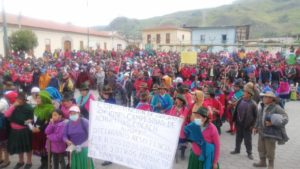
The general strike in Ecuador was initially called by the movement of indigenous people (CONAIE) and has been underway since Monday 13 June.  The strike and mass protests are growing in support among workers, but have been met by a massive wave of repression by the Lasso government including the illegal detention of indigenous leader Leonidas Iza, mass arrests and police brutality including the killing of an 18 year old indigenous protestor and at least four others (see below for Latest News and https://www.ecosocialist.scot/?p=1277 for background).

We are targeting this petition at both the workers movement and the climate justice movement.  The 10 demands of the movement relate not just to the harsh economic conditions of the people through rising prices of food and fuel while workers’ incomes fall, but are also against the exploitation of the natural environment and extraction of resources that has devastated indigenous people’s across Ecuador, the entire continent and the world.  The demands include opposition to privatisation of public services and the need for investment in education and health.

The petition can be found on the ipetitions website (link below) and can also be signed on a Google form.  ipetitions will display the total global signatories, but if you also fill in the form to share your details we’ll be able to publicise your designation and area of activity.  The list below will therefore extend.  We call on all activists in the workers and climate justice movement to both sign and promote the petition on social media and through your organisations.  The world needs to support the movement of indigenous peoples, workers and environmental activists in Ecuador in their hour of need.

LATEST EVENTS from our correspondents on the ground – updated 25 June 2022

The Ecuador National Assembly is debating online a motion of no confidence in President Lasso though it seems doubtful that it will be passed.  President Lasso has suspended the State of Emergency order, in a blatant attempt to try to void the no confidence motion.  But the repression against demonstrators continues, as show in videos below.  Many thousands more indigenous protestors have mobilised to reinforce those already in the capital, Quito.

Police brutality against protesters in Quito on Friday.

Indigenous communities in Chimboraza in the central highlands send reinforcements to the protests in capital Quito

Indigenous communities in Chimboraza in the central highlands send reinforcements to the protests in capital Quito (Facebook video)

Thursday 23 June report

Thursday, the eleventh day of the national strike in Ecuador, was a very intense day. It began with an important victory for the indigenous-led movement. Thousands of mainly indigenous protesters managed to reoccupy, entirely peacefully, the main cultural centre in Quito, the Casa de Cultura. This is where the indigenous movement has traditionally found shelter when it mobilises in the capital. It was their centre of operations during the uprising of October 2019. However, as part of its state of emergency, the government had sent the army and police to seal off the building and its grounds. This made it much more difficult this time for the indigenous contingents arriving in Quito to find shelter and have a coordinated logistical and symbolic centre. They had been more spread out around various university campuses that had partially allowed them in. Some were left sleeping out in the cold.

The fact that on Thursday, faced with a huge swell of protesters outside, the security forces simply let them in, was interpreted as a possible, significant concession by the government. A massive and euphoric rally of indigenous and other protesters took place in the main auditorium, addressed, in particular, by Leonidas Iza, the undisputed, central leader of the strike. There was talk of more concessions and the possibility of meaningful talks, with results, as the movement has been putting it, with the government.

However, a little later, part of the movement, led by indigenous women, began to march from the House of Culture to the National Assembly, to put pressure on them. There have been so-far unsuccessful attempts there to revoke the president’s decrees of a state of emergency. This march was met with very severe repression from the police and army, using tear gas, water cannon and live, buckshot, ammunition. At least one young man died after receiving multiple pellet shots in his chest and neck. As night fell, groups of police on motorbikes also attacked at least one of the humanitarian locations where people from the local community were distributing food to indingenous protesters. In one case the police fired pistols at the group as they ate, wounding at least one of them. There are reports of another death as well, taking the total so far to at least four.

Another worrying development is that sections of the middle-class, racist right in Quito have begun to mobilise against the protests. There are reports of groups of white-shirted young man driving around and abusing isolated individuals or vulnerable groups of indigenous protesters, shouting racist abuse at the “f****** indians” and telling them to go home. It is not clear if there have been physical attacks, but some of these vigilantes seem to be carrying guns. The right also mobilised a march of a few thousand towards the area where the protesters are concentrated, but they didn’t get very far and soon turned back to their base in the affluent neighbourhoods of north-central Quito.

Thank you for your support.

ecosocialist.scot

Link to Petition: https://www.ipetitions.com/petition/stop-the-repression-in-ecuador

Send us your details if you sign: https://forms.gle/jFzJ5T7a4VTDa2VL9

______________________________

Text of petition and signatories (English/Spanish)

Stop the repression in Ecuador, Solidarity with the Indigenous-led strike! / Alto a la represión en Ecuador, Solidaridad con el paro Indígena

To also have your name publicly associated with this petition, please complete the form here: https://forms.gle/jFzJ5T7a4VTDa2VL9 This petition was initially organised by ecosocialist.scot  / Para que su nombre también se asocie públicamente con esta petición, complete el formulario aquí: https://forms.gle/jFzJ5T7a4VTDa2VL9 Esta petición fue organizada inicialmente por ecosocialist.scot


STOP THE REPRESSION IN ECUADOR, SOLIDARITY WITH THE INDIGENOUS-LED STRIKE!

“The repression against the nationwide strike called by the indigenous movement in Ecuador has only increased since President Guillermo Lasso first declared a state of emergency and a curfew on Friday, 17 June. The police and army have been using brutal force, tear gas, stun grenades, pellet shot, to stop thousands of peaceful indigenous protesters from entering the capital, Quito. At least one protester has died, three are reported to be in a critical condition, dozens more have been wounded or arrested. The army and police have sealed off the House of Culture and several university campuses in an attempt to deny the indigenous protesters their traditional places of shelter in the capital. An immense citizen effort is underway, from students, women’s groups, neighbourhood organisations and the population in general, to collect food, blankets and basic provisions for the protesters who have made it into Quito.

Massive mobilisations and road blocks continue in indigenous territories across Ecuador. The local Governor’s offices have been occupied in at least three provinces.

Secondary school and university students, teachers, health workers, trade unionists, neighbourhood organisations and the feminist movement are mobilising in towns and cities.

Bus drivers, taxi drivers and truckers have either promised stoppages or already joined in the road blocks.

We the undersigned, demand an immediate end to the violent repression of peaceful protesters in Ecuador. We call on President Lasso and the government of Ecuador to lift the state of emergency, release those still in detention and drop all charges against the movement’s best known leader, Leonidas Iza, President of Conaie, who was illegally detained on 14 June and released 24 hours later, but who still faces charges that carry a possible prison sentence of 1-3 years.

In place of a military response, we urge President Lasso to engage in serious negotiations with the indigenous movement and other social movements, to address their just demands.

These include the 10 points put forward by Conaie – including fair prices for agricultural products; freezing of fuel prices because this generates price increases; respect for the collective rights of indigenous peoples and nationalities; a budget for health and education; an end to the voracious extractivism in indigenous territories; stop speculation and rising prices of basic food basket items; stop the privatisation of strategic sectors; public policies to curb the wave of violence.

These have since been enriched by other social movements incorporating their own demands, for example for public polices to curb gender violence and femicide.

The victory of Gustavo Petro and Francia Marquez in the presidential elections in neighbouring Colombia, show that the people of the region want to turn the page on decades of neoliberal economic policies that only generate poverty, violence, racial exclusion and the destruction of mother earth. We stand in solidarity with all their struggles and with the indigenous-led strike in Ecuador.”

ALTO A LA REPRESIÓN EN ECUADOR, SOLIDARIDAD CON EL PARO INDÍGENA

“La represión contra el paro nacional convocado por el movimiento indígena en Ecuador no ha hecho más que aumentar desde que el presidente Guillermo Lasso declaró el estado de excepción y el toque de queda el viernes 17 de junio. La policía y el ejército han utilizado una fuerza brutal, gases lacrimógenos, granadas de aturdimiento y perdigones, para impedir que miles de manifestantes indígenas pacíficos entren en la capital, Quito. Al menos un manifestante ha muerto, tres se encuentran en estado crítico y docenas más han sido heridos o detenidos. El ejército y la policía han acordonado la Casa de la Cultura y varios campus universitarios en un intento de negar a los manifestantes indígenas sus lugares tradicionales de refugio en la capital. Está en marcha un inmenso esfuerzo ciudadano, por parte de estudiantes, grupos de mujeres, organizaciones vecinales y la población en general, para recoger alimentos, mantas y provisiones básicas para los manifestantes que han conseguido entrar en Quito.

Continúan las movilizaciones masivas y los bloqueos de carreteras en los territorios indígenas de todo Ecuador. Las gobernaciones locales han sido ocupadas en al menos tres provincias.

Estudiantes de secundaria y universitarios, profesores, personal sanitario, sindicalistas, organizaciones vecinales y el movimiento feminista se movilizan en pueblos y ciudades.

Los conductores de autobuses, taxistas y camioneros han prometido paros o ya se han sumado a los cortes de carretera.

Nosotros, los abajo firmantes, exigimos el cese inmediato de la represión violenta de los manifestantes pacíficos en Ecuador. Pedimos al presidente Lasso y al gobierno de Ecuador que levanten el estado de excepción, liberen a los que aún están detenidos y retiren todos los cargos contra el líder más conocido del movimiento, Leonidas Iza, presidente de la Conaie, que fue detenido ilegalmente el 14 de junio y liberado 24 horas después, pero que aún se enfrenta a cargos que conllevan una posible condena de prisión de 1 a 3 años.

En lugar de una respuesta militar, instamos al presidente Lasso a entablar negociaciones serias con el movimiento indígena y otros movimientos sociales, para atender sus justas demandas.

Entre ellas se encuentran los 10 puntos planteados por la Conaie, entre ellos, precios justos para los productos agropecuarios; congelación de los precios de los combustibles porque esto genera aumentos de precios; respeto a los derechos colectivos de los pueblos y nacionalidades indígenas; presupuesto para la salud y la educación; fin del extractivismo voraz en los territorios indígenas; freno a la especulación y al aumento de los precios de los productos de la canasta básica; freno a la privatización de los sectores estratégicos; políticas públicas para frenar la ola de violencia.

Desde entonces se han enriquecido con otros movimientos sociales que han incorporado sus propias demandas, por ejemplo, políticas públicas para frenar la violencia de género y el feminicidio.

La victoria de Gustavo Petro y Francia Márquez en las elecciones presidenciales de la vecina Colombia, demuestran que los pueblos de la región quieren darle vuelta a la página de décadas de políticas económicas neoliberales que sólo generan pobreza, violencia, exclusión racial y destrucción de la madre tierra. Nos solidarizamos con todas sus luchas y con la huelga liderada por los indígenas en Ecuador”.

Initial list of Signatories (22 June 2022/22 junio 2022)

Miguel Urbán, Member of European Parliament/Eurodiputado, Anticapitalistas (Spanish State/Estado Español)

Martín Mosquera (Argentina)

Senador Rafael Bernabe (Puerto Rico)

Luis Bonilla. Otras Voces en Educación (Venezuela)

Olmedo Beluche por el Polo Ciudadano (Panamá)

Josefina Chávez (México)

Eduardo Lucita , EDI, (Argentina)

Eric Toussaint, Portavoz de CADTM (Belgium/Bélgica)

Edgard Sánchez (México)

Manuel Rodríguez Banchs. Democracia Socialista (Puerto Rico)

Joao Machado Borges Neto (Brazil/Brasil)

Tárzia Maria de Medeiros (Brazil/Brasil)

Stalin Pérez Borges. LUCHAS (Venezuela)

Ana Cristina Carvalhaes Machado (Brazil/Brasil)

Fernanda Melchionna, diputada federal/PSOL Rio Grande do Sul (Brazil/Brasil)

Sâmia Bomfim, diputado federal/PSOL São Paulo (Brazil/Brasil)

Vivi Reis, diputada federal/ PSOL Pará (Brazil/Brasil)

Luciana Genro, diputada estadual/ PSOL Rio Grande do Sul (Brazil/Brasil)

Roberto Robain, dirigente del MES/PSOL /concejal de Porto Alegre (Brazil/Brasil)

Israel Dutra, Secretario general del PSOL (Brazil/Brasil)

Pedro Fuentes, dirigente del MES/PSOL (Brazil/Brasil)

Bruno Magalhaes, dirigente del MES/PSOL (Brazil/Brasil)

Philippe Pierre-Charles Groupe Révolution Socialiste (Martinique/Martinica)

Daniel Libreros. Movimiento Ecosocialista (Colombia)

Franck Gaudichaud France Amérique Latine (France/Francia)

Béatrice Whitaker (France/Francia)

Pierre Rousset, NPA, (France/Francia)

Richard Neuville, ENSEMBLE (France/Francia)

Renato Roseno, diputado de Ceará/PSOL (Brazil/Brasil)

Mario Barreto, presidente de PSOL Río de Janeiro (Brazil/Brasil)

Nadja Carvalho, Isabel Lessa y Fernando Silva del Directorio Nacional del PSOL (Brazil/Brasil)

Mike Picken, ecosocialist.scot (Scotland/Escosia – UK)

Iain Gault, ecosocialist.scot (Scotland/Escosia – UK)

Terry Conway, Anti*Capitalist Resistance (England/Inglaterra – UK)

Iain Bruce, journalist/periodista (Scotland/Escosia – UK)

Frances Curran, Former member of Scottish Parliament/Socialists for Independence (Scotland/Escosia – UK)

Jim Bollan, Councillor – West Dunbartonshire, (Scotland/Escosia – UK)

Stephen Smellie, Unison Scotland (personal capacity) (Scotland/Escosia – UK)

John Rees, socialist activist (England/Inglaterra – UK)

Barry Sheppard (USA)

Jeff Mackler, National Secretary Socialist Action (USA)

Mónica Baltodano,  Integrante de la Articulación de Movimientos Sociales (Nicaragua)

Oly Millán,  Integrante de la Plataforma Ciudadana en Defensa de la Constitución (Venezuela)

Tarcísio Mota, Chico Alencar, Monica Benício y William Siri, councillors/concejales/as de Rio de Janeiro (Brazil/Brasil)

Mônica Francisco, State Deputy /diputada de estado Rio de Janeiro (Brazil/Brasil)

Orlando Barrante, Movimiento de Trabajadores y camponeses – MTC (Costa Rica)

Luana Alves, City Councillor/Vereadora São Paulo, Executiva nacional do PSOL (Brazil/Brasil)

Humberto Meza, Comite Brasileño de Solidaridad con Nicaragua (Brazil/Brasil)

Fernando Carneir, city councillor/ vereador Belém-Pa PSOL (Brazil/Brasil)

Aurelio Robles, Coordinador del Movimiento Alternativa Socialista-MAS (Panamá).

Mariana Riscali, Nat Sec Finance/Secretária Nacional de Finanças do PSOL (Brazil/Brasil)

Monica Seixas, deputada estadual São Paulo (Brazil/Brasil)

Mariana Conti – City Councillor/Vereadora Campinas, São Paulo (Brazil/Brasil)

Fábio Felix, Dep. Distrital Brasília (Brazil/Brasil)

Josemar, City Councillor/Vereador São Gonçalo RJ (Brazil/Brasil)

Pedro Ruas, City Councillor/Vereador Porto Alegre RS (Brazil/Brasil)

Jurandir Silva, City Councillor/Vereador Pelotas RS (Brazil/Brasil)


Ecuador: Indigenous leader released after mass protests

Leonidas Iza is free but a national strike continues in Ecuador, writes  María Isabel Altamirano Solarte for ecosocialist.scot.

After 24 hours of illegal detention, Leonidas Iza was finally released.

Iza is president of CONAIE (Confederation of Indigenous Nationalities of Ecuador), which is the largest organisation in Ecuador bringing together the majority of indigenous peoples and nationalities. His release has been a triumph of social mobilisation and international solidarity.

Leonidas Iza was arrested by elite forces of the national police and the Armed Forces in a violent and illegal manner, accused of “paralysing a public service” and incitment. His entire detention process was outside the framework of Ecuadorian law.

His release is a triumph of popular pressure and international solidarity. On the one hand, the affiliated organisations of CONAIE have come out more forcefully to express their discontent in their territories and in different cities of the country.

In Cotopaxi, the province where Leonidas Iza is from, the communities filled the streets of the main city, Latacunga. When they heard that their leader was being transferred to the Military Fort of Cotopaxi, they went there to demand his release.

In Quito, the capital of Ecuador, young people, university students, feminists, dissidents and ordinary people have also joined the mobilisation in the vicinity of the National State Prosecutor’s Office to demand the release of the political detainees and to express their demands for education, health and non-violence by the state.

International Solidarity

International solidarity has been very important, with messages of support for Leonidas Iza and rejection of the persecution of political leaders, as well as other demonstrations such as the collection of signatures to demand his release.

The government of the banker Lasso, who seeks to impose neoliberal policies, has been totally inept in responding to the fair demands of the population and CONAIE.  These demands include fair prices for agricultural products; freezing of fuel prices because this generates price increases; access to employment and no job insecurity; respect for the collective rights of peoples and nationalities, budget for health and education; stop the voracious extractivism in indigenous territories; stop speculation and rising prices of basic food basket items; stop the privatisation of strategic sectors; generation of policies to curb the wave of violence and hired killings; public policies to curb gender violence and femicide.

But this government has taken up again the National Security doctrines of the ‘internal enemy’, persecuting and criminalising social activists and indigenous leaders, women, students, workers, etc. Under this logic, eight young leaders of the Guevarist Movement were arrested a month ago. And now, in the context of the National Strike called by CONAIE, Leonidas Iza has been arrested. But they have also arrested other indigenous leaders of CONAIE’s affiliated organisations, young students and women who took to the streets to protest and demand their rights during these two days of the National Strike.

In addition, during these two days there have been very strong acts of repression, and there have been injuries with tear gas bombs and even pellets. Social communicators were attacked by members of the national police. But in these two days of the National Strike the mobilisation has also grown and strengthened.

Although his release is a victory for mass protests and international solidarity, Leonidas Iza still faces charges and a possible prison sentence for his role in the strike.  Worldwide solidarity needs to be stepped up to call for all charges to be dropped and for the Ecuador government to grant the just demands of the strike movement.

Protests were taking place across Ecuador (Pic @CONAIE_Ecuador)

CONAIE is the largest organisation in Ecuador bringing together the majority of indigenous peoples and nationalities


Solidarity with the uprising in Kazakhstan! Online meeting 22 January and updated Statement


Around 200 activists from over 40 countries have signed have signed a worldwide statement of solidarity with the uprising in Kazakhstan – published below.

The statement was coordinated by Paul Murphy, an eco-socialist member (TD) of the parliament in the Republic of Ireland state and includes members of parliament in Ireland, Denmark and Switzerland, city councillors in Greece and Sweden, a member of the European Parliament from the Spanish State, and dozens of trade union, socialist, and human rights activists from around the globe.  ecosocialist.scot is delighted to sign the statement and among the other signatories from Scotland are Frances Curran, former Scottish Socialist Party Member of the Scottish Parliament and activist in Socialists for Independence, Glasgow SNP councillor Graham Campbell, members of the Republican Socialist Platform and ScotE3 organisations, and other trade union, community, independence and socialist activists.

The statement rejects the idea that the uprising in Kazakhstan is a result of foreign intervention but is about the rights and demands of working people sick of a tyrannical dictatorship.  It calls for the overthrow of this dictatorship and the rights of working people to control democratically the vast natural resources and wealth of Kazakhstan.  The statement also rejects the intervention of foreign troops from the Russian state and condemns the hypocrisy of the EU and USA.

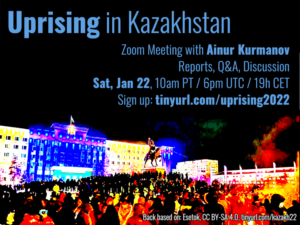
There will be an online public meeting organised by the statement coordinators and supported by ecosocialist.scot on Saturday 22 January 6pm GMT/UTC.  The meeting has also been sponsored by the Republican Socialist Platform in Scotland and Anti Capitalist Resistance (England/Wales).  Sign up at: tinyurl.com/uprising2022

Zoom meeting, Saturday, January 22nd, 10am PT / 6pm UTC/GMT   / 19h CET

Ainur Kurmanov, Socialist Movement Kazakhstan – with a report, Q&A and discussion.

This meeting is organized by AntiCapitalist Resistance (England and Wales), Lernen im Kampf (Germany), RISE (Ireland), Reform & Revolution caucus in DSA (USA).  Supported by ecosocialist.scot and Republican Socialist Platform (Scotland).


Solidarity with the uprising in Kazakhstan

We, socialists, trade unionists, human rights activists, anti-war activists and organisations have watched the uprising in Kazakhstan since 2 January with a sense of deep solidarity for the working people. The striking oil workers, miners and protesters have faced incredible repression. The full force of the police and army have been unleashed against them, instructed to ‘shoot to kill without warning’. Over 160 protesters have been killed so far and more than 8,000 have been arrested.

We reject the propaganda of the dictatorship that this uprising is a product of “Islamic radicals” or the intervention of US imperialism. There is no evidence of that whatsoever. It is the usual resort of an unpopular regime – to blame ‘outside’ agitators.

Instead, the trigger of the protests was the rise in fuel prices. This was the straw that broke the camel’s back, in a country where immense oil wealth exists side by side with terrible poverty and exploitation. It is also the result of the crushing weight of a brutal dictatorship on people’s backs. This regime has liquidated all opposition parties, imprisoned and tortured trade union and human rights activists, and was responsible for a massacre of striking oil workers in Zhanaozen ten years ago.

The position of all the major capitalist powers is clear. Putin stands full square behind the regime. The Russian-led Collective Security Treaty Organisation (CSTO) has sent 3,000 troops to Kazakhstan to intimidate protesters. Chinese President Xi Jinping also announced his support for the Kazakhstan government and claimed the unrest was the deliberate result of “outside forces.”

The US administration has called for “restraint by both the authorities and protestors”. The EU has similarly called on protesters to “avoid any incitement to violence” and called on authorities “to respect the fundamental right to peaceful protest and proportionality in the use of force when defending its legitimate security interests”!

Unsurprisingly, they all prioritise ‘stability’ for their oil companies who are benefiting from the exploitation of the natural resources and Kazakh workers.

In response to the class solidarity of the capitalist regimes, we respond with working class solidarity and commit to raise the following demands in our trade unions, parliaments and organisations:

  • Solidarity with those rising up against the dictatorship in Kazakhstan

  • End the repression of the protests

  • Release all the detained protesters and political prisoners

  • No to Russian and CSTO intervention – withdraw the troops now

  • No to the hypocrisy of the EU and US who equate the revolt of the masses with the brutal violence of the regime

  • Down with the dictatorship

  • Support the call from oil workers for nationalisation of the oil wealth and major industries under workers’ control

  • Support the building of an independent trade union movement and socialist movement in Kazakhstan

Add your name to the solidarity statement

By filling in the form below and clicking the ‘Sign the statement’ button you are agreeing to have your name added to the public list of signatories of this statement and to be contacted with updates about future Kazakstan solidarity statements and actions should they be needed.

Name 
Are you signing in a personal capacity?

Albania

Redi Muci

Aotearoa / New Zealand

International Socialist Organisation

Joe Carolan, Unite Union, Senior Organiser

Argentina

Christian Castillo, por la Dirección Nacional del Partido de los Trabajadores Socialistas (PTS)

Nicolás del Caño, Diputado Nacional por la Provincia de Buenos Aires por el Frente de Izquierda y de los Trabajadores – Unidad, dirigente del Partido de los Trabajadores Socialistas (PTS)

Myriam Bregman, Diputada Nacional por la Ciudad de Buenos Aires por el Frente de Izquierda y de los Trabajadores – Unidad, PTS,  Abogada del CEPRODH – Centro de Profesionales por los Derechos Humanos

Alejandro Vilca, Diputado Nacional por la Provincia de Jujuy por el Frente de Izquierda y de los Trabajadores – Unidad, dirigente del Partido de los Trabajadores Socialistas (PTS)

Raúl Godoy, ex Diputado provincial de Neuquén por el Frente de Izquierda. Dirigente del PTS, ex Secretario General de SOECN (Sindicato de Obreros Ceramistas), obrero de la fábrica ex–Zanon recuperada por sus trabajadores

Eduardo Ayala, trabajador de Madygraf (ex Gráfica Donneley recuperada por sus trabajadores), PTS

Claudio Dellecarbonara, dirigente por la minoría de Asociación Gremial de Trabajadores del Subte y Premetro (AGTSYP)  y referente de línea B de Subterráneos Buenos Aires. Diputado Provincial (Buenos Aires) electo por el Frente de Izquierda y de los Trabajadores Unidad, PTS

Australia

Caitlin Doyle-Markwick, Solidarity (IST), Media Entertainment and Arts Alliance

Miroslav Sandev, Solidarity / Teacher’s Federation

Luke Alexander, NTEU

Dani Cotton, National Tertiary Education Union, Branch Committee, University of Sydney

Susan Price

Mick Armstrong, Socialist Alternative, National Executive

Austria

Christian Zeller, Netzwerk Ökosozialismus, Global Ecosocialist Network, Professor of Economic Geography, University of Salzburg

Manfred Ecker, Gewerkschaft der Privatangestellten GPA, Member

David Heuser, Linkswende

Heidi Specht, Arbeiter*innenstandpunkt

Karin Wilfingseder, GPA (Trade Union), Shop Steward

Belgium

Daniel Tanuro, Gauche anticapitaliste, Ecosocialist author

Jean Vogel, Marcel Liebman Insitute, President

Eric Toussaint, Fourth International, international activist & historian

Freddy Mathieu, FGTB, Ancien Secrétaire Régional

SAP – Antikapitalisten / Gauche anticapitaliste

Nick Van de Vel

Britain / England and Wales

Simon Hannah, Lambeth UNISON, Joint Branch Secretary

Fiona Lali, Marxist Student Federation (MSF)

Anne Alexander, Middle East Solidarity magazine, Co-editor

Labour Representation Committee (LRC)

Neil Faulkner, , Archaeologist, historian and writer

Kazakh Solidarity Campaign

John McInally, Public & Commercial Services Union, Former Vice-President

Socialist Appeal

Workers Power

Ukraine Solidarity Campaign

Alex Callinicos, Emeritus Professor of European Studies, King’s College London

Andy Richards, UNISON, Brighton and Hove Branch Chair

Gareth Jenkins, SWP

Jon Woods, Portsmouth City UNISON, Chair

Gilbert Achcar, UCU, Professor

Michael Tucker

Ian Parker, Unite

Andrew Kilmister, Oxford Brookes University UCU (Universities and Colleges Union), Branch Secretary

Rowan Fortune, Anti*Capitalist Resistance, EC Member

Penny Foskett, SWP.  NEU

Tony Foley, NEU, England

ACR, Anti*Capitalist Resistance, England and Wales

Alan Thornett, UNITE

Nigel Smyth

Elizabeth Lawrence, University and College Union (personal capacity)

Canada

Liam Chiasson

Costa Rica

Paola Zeledón, editora de La Izquierda Diario Costa Rica.

Fernanda Quirós, dirigente de Pan y Rosas Costa Rica

Esteban Fernández, dirigente de OSR, profesor de filosofía UCR.

China

Liu Haoyu

Fan Zeng

陈 归尘

Peter Yang

Cuba

Frank García Hernández, Comunistas Cuba blog, member of the Editorial Board

Cyprus

Athina Kariati, NEDA – New Internationalist Left

New Internationalist Left, NEDA

Denmark

Søren Sondergaard, Red-Green Alliance, Member of Danish Parliament, spokesperson on European Affairs

Lene Junker, Internationale Socialister

Dominican Republic

Movimiento Socialista de Trabajadoras y Trabajadores, MST

France

Christian Mahieux, International Labour Network of Solidarity and Struggles

Malewski Jan, Inprecor (révue), rédacteur

Penelope Duggan, International Viewpoint, Editor

Michael Löwy

Nouveau Parti Anticapitaliste / New Anticapitalist Party

Anasse Kazib, rail worker, Sud Rail, candidate to the French presidency for Révolution Permanente

Adrien Cornet, refinery worker (Grandspuit), CGT Total, Révolution Permanente

Philippe Alcoy, RévolutionPermanente.fr, editorial board

Germany

Yaak Pabst, Redaktion marx21-Magazin

Michael Findeisen, Fellow

Joachim Ladwig, Verdi

Daniel Behruzi, ver.di TU Darmstadt (Trade Union), Shop Stewards Speaker

Alexander Keim, LiK/ die Linke/Verdi

Internationale Sozialistische Organisation (ISO)

Dr. Winfried Wolf, Lunapark21 – Zeitschrift zur Kritik der globalen Ökonomie, responsable in the editorial board of LP21-Magazine

Aron Amm, Lernen im Kampf

Martin Suchanek, Gruppe ArbeiterInnenmacht, Germany section of League for the Fifth International, Editor of journal “Revolutionärer Marxismus”

Wilhelm Schulz, Gruppe ArbeiterInnenmacht, German Section of the League for the Fifth International

Jaqueline K. Singh, REVOLUTION – international communist youth organisation Germany

Matthias Fritz, former TU converer (VK-Leiter) IG Metall Mahle

Oskar Fischer, Soziologe, Revolutionäre Internationalistische Organisation

Stefan Schneider, Politologe, Revolutionäre Internationalistische Organisation

Charlotte Ruga, Hebamme, Revolutionäre Internationalistische Organisation

Tabea Winter, Studentin, Revolutionäre Internationalistische Organisation

Thies Gleiss, Die Linke, Member of National Party Executive

Christph Waelz, German Education Union, GEW Barlin-Pankow (personal capacity)

Greece

Panos Garganas, Sosialistiko Ergatiko Komma (SEK), Editor Workers Solidarity weekly

Editorial Team of Elaliberta.gr, www.elaliberta.gr, Athens

Serafeim Rizos, Chania city/Union of Teachers-Chania, councilor Chania/member of board of Teachers Union Chania

Thanasis Diavolakis, Peiraus city/Teachers Federation of private schools, councilor Peiraus city/member of board of OIELE

Katerina Thoidou, Nikaia-Renti city, councillor

Maria Styllou, Sosialismos apo ta kato Review, Editor

Thanasis Kampagiannis, Athens Bar Association Board, Elected councillor (personal capacity)

ANTARSYA, Front of the anticapitalist Left

Xekinima – Internationalist Socialist Organization

NAR, New Left Current

Manthos Tavoularis, Docker, trade unionist

Tassos Anastassiadis, member of General Council of POESY (Federation of Greek journalists)

TPT (Fourth International Programmatic Tendency, Greek Section of 4th International)

Petros Constantinou, Athens city/KEERFA-Movement United Against Racism and Fascist Threat, councillor Athens city/coordinator of KEERFA

Aphrodite Fragkou, Marousi city, councillor

Dimitris Zotos, Lawyers Association of Athens, Civil action Golden Dawn trial

India

Rohini Hensman, Internationalism from Below, Writer, researcher and activist

Sushovan Dhar, Vice-President, Progressive Plantation Workers Union (PPWU)

International

International Marxist Tendency

Revolutionary Communist International Tendency (www.thecommunists.net)

Pierre Rousset, international activist

Iran

Morad Shirin, Shahrokh Zamani Action Campaign, International Organiser

Maziar Razi, Iranian Revolutionary Marxists’ Tendency, Spokesperson

Ireland

Bríd Smith, People Before Profit, TD (Member of Parliament)

Paul Murphy, People Before Profit, TD (Member of Parliament)

Gino Kenny, People Before Profit, TD (Member of Parliament)

Richard Boyd Barrett, People Before Profit, TD (Member of Parliament)

Gerry Carroll, People Before Profit, MLA (Member of the Legislative Assembly)

Mick Barry, Solidarity and Socialist Party, TD (Member of Parliament)

People Before Profit

Socialist Democracy

Goretti Horgan, People Before Profit

Jess Spear, RISE, National Organiser

John Molyneux, People Before Profit, Unite The Union., Editor, Irish Marxist Review

Ailbhe Smyth, Le Cheile: Diversity Not Division, Member

Eddie Conlon, Teachers Union of Ireland, Member/Former National Hon Secretary

Emilio Maira, People Before Profit

Memet Uludağ, Unite the Union, Union Rep

Shaun Harkin, People Before Profit, People Before Profit Cllr Derry City and Strabane District Council

Mark Price

Mark Finnegan, People Before Profit

Italy

Giacomo Turci, La Voce delle Lotte, editor

Scilla Di Pietro, Il Pane e le Rose feminist current, spokesperson

Mary Rizzo, Le Voci della Libertà, Activist / Translator

Japan

Tsutomu Teramoto, Japan Revolutionary Communist League (JRCL)

JRCL (Japan Revolutionary Communist League)

México

Jose Manuel Aguilar Mora, Universidad Autónoma de la Ciudad de México & Member of La Liga De Unidad Socialista (LUS), Professor-Researcher, Partido Revolucionario de los Trabajadores

Edgard Sánchez, Partido Revolucionario de los Trabajadores

Flora Aco González, trabajadora estatal reinstalada, ex aspirante a candidata a diputada por el Frente de Izquierda Anticapitalista en la Ciudad de México, MTS

Sulem Estrada, maestra de secundaria, ex candidata anticapitalista al Congreso de la Ciudad de México, Agrupación Nuestra Clase , MTS

Miriam Hernandez, trabajadora de la UNAM, ex candidata anticapitalista al Congreso de la CdMX, MTS

Mario Caballero, Movimiento de las y los Trabajadores Socialistas

Nancy Cazares y Alex Osorio, ex presos políticos de 10 de junio de 2013, MTS

Nigeria

Salako Kayode, Revolutionary socialist movement, Spokesperson

Dimeji Macaulay, Revolutionary Socialist Movement, National Organiser

Revolutionary Socialist Movement

Poland

Andrzej Żebrowski, Pracownicza Demokracja (Workers Democracy)

Agnieszka Kaleta

Michał Wysocki, Pracownicza Demokracja (Workers’ Democracy), worker

Filip Ilkowski Associate Professor, Polish Teachers Union at the University of Warsaw, Member of the Presidium of the Council for Higher Education and Science of the Polish Teachers Union

Bronislaw Czarnocha, Hostos CC/CUNY (personal capacity)

Portugal

Semear o futura

Russia

Daria, IST Russia,

Semyon, Trotskyist

Socialist Tendency (IST)

Denis Zagladkin, Socialist Tendency

Scotland

Paul Inglis, Radical Independence Campaign, Glasgow City Branch Unison, Clydeside IWW, Partick Living Rent, Member

Connor Beaton, Republican Socialist Platform, Secretary

Allan Armstrong, Republican Socialist Platform, Educational Institute of Scotland (life member)

Frances Curran, Former member of parliament and member of Socialist for Independence

Pete Cannell, Scot.E3 (Employment, Energy and Environment), Secretary

Bob Goupillot, Radical Independence Campaign Edinburgh, (Personal Capacity)

Ecosocialist.scot (organisation), ecosocialist.scot

Graham Campbell, SNP Councillor in Glasgow Glasow (personal capacity)

Campbell McGregor, Scottish Socialist Party / UNISON

Donny Gluckstein, SWP, Educational Institute of Scotland, EIS Council

South Africa

Mametlwe Sebei, President, General Industries Workers Union of South Africa

South Korea

Workers’ Solidarity

Spanish State   

Anticapitalistas

David Karvala, Social movement activist and member of Marx21.net, Catalunya

Carlos de Pablo Torrecilla, UGT de Catalunya , Secretari de Política Institucional, Catalunya

Gerardo Pisarello, Unidas Podemos-En Comú Podem, member of the Spanish Congress, and First Secretary of the Bureau of the Congress

Miguel Urbán Crespo, Anticapitalistas, Member of the European Parliament

Marx21.net

Santiago Lupe, portavoz de la Corriente Revolucionaria de Trabajadores y Trabajadoras – CRT, historiador

Lucía Nistal, doctora en Teoría Literaria Universidad Autónoma de Madrid (UAM), impulsora de Referéndum UAM y portavoz de CRT

Juan Carrique, abogado laboralista, miembro de la Asociación Libre de Abogadas y Abogados, afiliado a CGT

Josefina L. Martínez, periodista, historiadora, escritora, editora revista Contrapunto

Asier Ubico, presidente del Comité de Empresa de Telepizza por CGT – Zaragoza

Juan Carlos Arias Sanz, delegado por UGT de la Consejería de Políticas Sociales y Familia de la Comunidad de Madrid

Cynthia Lub, doctora en Historia, escritora, editora de Esquerra Diari.cat y afiliada a CGT Lleure

Maria Dantas, ERC, social movement activist in Catalunya, Member of the Congress of Deputies

Omar Noumri Coca, Mayor of Castelló de Farfanya (Catalunya) , member of ERC.

Rodrigo Díaz López, Unión de Juventudes Comunistas de España

Enrique Fernando Santiago, Secretario General del PCE y Secretario de Estado de España, en representación de todo el PCE

Pedro Cortés Costoya, Unión de Juventudes Comunistas de España (UJCE).

Switzerland

Manuel Sepulveda, Mouvement pour le Socialisme, Militant actif

Stéfanie Prezioso, Ensemble à Gauche, Member of Parliament

Jean BATOU, Ensemble à Gauche, Member of parliament (Geneva)

Philipp Schmid, Movement for Socialism, teacher and union activist

Christian Zeller, Network Ecosocialism and Global Ecosocialist Network, Professor of Economic Geography

Corriente Revolucionaria de Trabajadoras y Trabajadores (CRT, miembro de la FT-CI) (Estado Español)

Hannah, Bewegung für den Sozialismus

Sweden

Jonas Brännberg, Rättvisepartiet Socialisterna – International Socialist Alternative, Member of Luleå City council

Arbetarmakt Workers Power

Syria

Jackal, Revolutionary Left Movement

Taiwan

黃梓豪, International Socialist Forward

Fang, International Socialist Forward

Nicholas Soo, International Socialist Forward

Turkey

Sosyalist Demokrasi için Yeniyol, Turkish section of IV. International

Ecehan Balta, Sosyalist Alternatif

Nihat Boyraz, Sosyalist Alternatif

Sosyalist Alternatif

Ukraine

Pavlo Viknyanskyy, («Республіка») political party (personal capacity)

USA

Andrew Berman, Veterans for Peace, Peace and Solidarity Activist

Brandon Madsen, Democratic Socialists of America / AFGE 2157

Reform & Revolution, Caucus of Democratic Socialists of America

Dan La Botz, New Politics, Co-Editor

Tyron Moore, Washington Federation of State Employees, Organizer

Phil Gasper, New Politics, Co-editor

Richard Burton, Montgomery County Education Association (ID purposes only), UniServ Director/Organizer

Tempest Collective

E. Reed, Boston Revolutionary Socialists, Coordinating Committee Member

David McNally, Editor in Chief, Spectre Journal, Professor of History, University of Houston

Steve Leigh, Seattle Revolutionary Socialists (*for identification purposes only)

Joel Geier

Sherry Wolf, Tempest Collective, author, Sexuality and Socialism

Socialist Resurgence

Charles Post, Tempest Collective, the Democratic Socialists of America (DSA), member of editorial board of Spectre: A Marxist Journal

Zachary Levenson, Editor, Spectre, Assistant Professor of Sociology, UNC Greensboro

Ashley Smith, Tempest Collective, Democratic Socialists of America*, National Writers Union* (*for identification purposes only)

Marx21, marx21us.org

Stephen Oren

Peter Ranis, Professor Emeritus, Political Science, Graduate Center, CUNY (personal capacity)

Elliot Podwill, PSC-CUNY    (personal capacity)

Carol Lang, PSC/AFT (personal capacity)

Howard Pflazer, PSC-CUNY (personal capacity)

Ruy Martinez, DSA (personal capacity)

Michael Beyer, DSA (personal capacity)

Thomas Harrison, New Politics editorial board member (personal capacity)

Paul Goodspeed, South New Hampshire DSA

Matthew Chociej

Frieda Afary, Producer of Iranian Progressives in Translation

Derek Bartholomew, Tempest Collective (personal capacity)

Criage Lynnette Althage, DSA member

Stephen Shalom, New Politics (personal capacity)

Somak Paul, DSA organiser (personal capacity)

Coco Smyth, Revolutionary Socialist Network (personal capacity)

Venezuela

Angel Árias, dirigente de la LTS, trabajador estatal

Suhey Ochoa, Pan y Rosas, trabajadora de Apps

Zimbabwe

Tafadzwa A Choto, ISO – Zimbabwe, Member


“Net Zero” – Still a Big Con!

Earlier on in the year, ecosocialist.scot reported on “The Big Con”, a report by Friends of the Earth International and other organisations on “net zero” – The Big Con: ‘Net zero’ emissions is a dangerous hoax.

Now we have further evidence of the way that “net zero” is being used by corporations to block climate policy with the publication of an set of case studies compiled by four campaigns listed below.

“Net Zero” is a significant policy campaign of both the Scottish government and the UK government, the Scottish government even has a dedicated website called “Net Zero Nation” with the slogan “Scotland. Let’s do net zero”.

But this research shows how “net zero” is an empty slogan and is being used as greenwashing by six major corporate players – BP, Microsoft, Drax, IETA, BlackRock and Shell.

One of the essential slogans of the COP26 Coalition call for a Global Day for Climate Justice on 6 November is

We Need Real Zero, Not Net Zero“.

This needs to ring and loudly and clearly across Glasgow and Scotland on 6 November!

We reproduce the press report from the Corporate Europe Observatory that links to the new evidence.


On the road to COP26, corporations are using “net zero” to block effective climate policy and greenwash their image while maintaining business-as-usual. Alongside Corporate AccountabilityFriends of the Earth International and Global Forest Coalition, CEO has looked into the “net zero” conning and COP26 greenwashing of six major corporate players, but they’re not alone.

In June 2021, more than 70 climate justice groups around the world launched a report, “The Big Con”. This report built on previous reports and analysis of “net zero” and revealed how Big Polluters across various economic sectors are advancing a “net zero” agenda to delay climate action, deceive the public, and deny the need for real, urgent, and meaningful action. This fact file builds on “The Big Con” by providing more detail on the “net zero” agendas of six major corporate players. These corporate actors include COP26 sponsors, Big Oil and Gas majors, and key influencers in the United Nations Framework Convention on Climate Change (UNFCCC), as well as in other “net zero” related initiatives such as the Taskforce on Scaling Voluntary Carbon Markets (TSVCM) and the Race to Zero.

Read the 2 page summary here

Read the more in-depth factfile here

Published by Corporate Europe Observatory, 28 October 2021


The ‘other’ COP: Biodiversity COP 15 – a virtual conference that achieved virtually nothing?


While COP26 on Climate Change in Glasgow is the focus of attention across the world, it’s also necessary to realise that there are other important aspects of the ecological crisis needing urgent action.  The first part of UN’s COP15 on Biodiversity took place online in October.  Protection of Biodiversity needs to be an important aspect of our environmental action in Scotland.   Sean Thompson of Red Green Labour has posted a report on the COP15 on Biodiversity that ecosocialist.scot is reproducing with kind permission.  


The preparations for COP 26 have understandably attracted increasing public and media attention in the run-up to the conference in November. Unfortunately this has tended to overshadow the equally vital COP 15 conference which took place on 11 – 15 October.

The conference, which to be pedantic comprised the 15th meeting of the Conference of the Parties (COP 15) to the Convention on Biological Diversity (CBD), the tenth Meeting of the Parties to the Cartagena Protocol on Biosafety (Cartagena Protocol COP/MOP 10), and the fourth Meeting of the Parties to the Nagoya Protocol on Access and Benefit-sharing (Nagoya Protocol COP/MOP 4), had already been postponed three times because of the Covid 19 pandemic and was finally reconfigured as a two part affair, the first virtual and the second, an actual face-to-face meeting, scheduled for April/May next year in Kunming, China.

Originally signed by 150 countries at the Rio Earth Summit in 1992 and later ratified by a further 45, significantly not including the United States, the Convention is designed to protect diversity of plant and animal species and ensure natural resources are used sustainably.

It also aims to achieve ‘fair and equitable sharing’ of benefits from natural genetic material, used in everything from medicines to new crop species. In practice that means making sure indigenous communities and countries home to biological riches benefit from their use.

Global targets to halt and reverse biodiversity loss have been set before, in both 2002 and 2010, but were largely missed by virtually every country. According to Georgina Chandler of RSPB, a number of countries, including Canada, the European Union, Costa Rica, Colombia and Britain are pushing for greater ambition on nature protection and have the aspiration that the summit  will set both long-term goals for 2050 and shorter-term targets for 2030 and, crucially, push for those to be enshrined in national policies.

However, in the event, most of the virtual meeting was taken up with procedural matters, with the secretariat noting “with concern that a number of Parties have not paid their contributions to the core budgets … for 2020 and prior years, including Parties that have never paid their contributions”. At the end of the conference, the Kunming Declaration was adopted. This was little more than a statement of good intentions, setting general ambitions for biodiversity protection, but not addressing questions about implementation or further commitments from governments.

Even so, there were some tentative signs of progress. The Declaration did at least note the growing support from countries for ‘30×30’, the aspiration to protect at least 30% of the Earth’s land and seas by 2030. At least 20 governments taking part in the meeting stressed the critical importance of the 30×30 goal, making it the most highlighted target by parties in the meeting. Among them was India, which has recently joined the High Ambition Coalition for Nature and People, a group of more than 70 countries pushing for the inclusion of 30×30 in the final biodiversity treaty. Significantly, although the USA is not party to the convention, Joe Biden has recently committed to protect at least 30% of his country’s land and coastal waters by 2030, as part of the international “30×30” campaign.

In addition, the host of the conference, China, announced a couple of positive, if comparatively modest, initiatives on the sidelines of the event; $230 million to establish the Kunming Biodiversity Fund to support biodiversity protection in developing countries, and the creation of new national parks in China covering an area of 230,000 square kilometres.

Of course, the proof of the pudding is in the eating. The virtual Part One of COP 15 did little more than set the scene for Part two in Kunming next spring. Between now and 25 April, the 195 countries that are signed up to the Convention will have negotiate the targets for the global biodiversity framework that governments will aim to meet by the end of the decade. The draft text of the framework includes proposals to reduce pesticide use by two-thirds and eliminate plastic pollution by the end of the decade as well as the 30×30 target. Whether those goals end up in the final agreement – and whether they are acted on – remains to be seen.

Originally published on Red Green Labour.

Protection of Scotland’s rich natural wildlife and biodiversity in the midst of the ecological crisis is an important aspect of ecosocialist campaigning

Photo by Gary Ellis on Unsplash


Norway shifts left – what implications for Scotland?


The result of the Norwegian general election on Monday 13 September showed a marked shift to the left in the important oil-producing European state, writes Mike Picken for ecosocialist.scot.

The three major right wing parties lost 20 seats between them in the 169 member parliament and the Conservative-led government has fallen.

The Conservative Party that has led the right wing coalition government since 2013 lost nine of its 45 seats, while the most right wing party in the parliament, the anti-immigrant Progress Party, lost six of its 27 seats.  The smaller Christian Democrat right wing party lost over half of its parliamentary seats to be reduced to just three.

The social democratic Labour Party has continued as largest party and the speculation is that it will lead what is probably a re-run of the three party coalition that ran Norway from 2005 to 2013.  Although its victory has been hailed as a ‘landslide’ and a triumph, the Labour Party nevertheless lost one seat in the election to fall to 48 seats, less than one third of the parliament.

The Labour Party is already seen as neo-liberal but will face strong pressure to move further right from its likely coalition partner, the Centre Party, which made the biggest gains winning an extra nine seats to take it to 28.

Left and Green gains

The election was dominated by the climate crisis and the most significant feature of the election for ecosocialists was the big increase in seats for the left and greens – the Socialist Left Party, the Red Party and the Green Party. All three parties work together in the environmental and other movements.

The Socialist Left Party was originally part of the traditional communist movement and gained two seats to move to 13 seats. The party has been faced with criticism from its left due to taking part in the Labour-led coalition from 2005 to 2013. (This period was called the ‘Red-Green’ coalition, though this is after the colours of the parties rather than a political description). The Centre Party are the likely coalition partner for Labour, but are publicly opposed to the inclusion of the Socialist Left Party in government now.  Given the shortfall in seats, so there could well follow a lengthy period of debate about whether the Socialist Left should join the Labour-led government, or support from the outside as the Left Bloc did in Portugal.

The significant winners from the far left was the Red Party which doubled its vote to 4.7% and gained seven seats to go from one seat to eight. The Red Party also describes itself as a communist party and has had a significant extra-parliamentary role focussing on defence of the welfare state in Norway, one of the key gains of the post war period.

Also gaining seats was the small Green Party which increased from one  to three seats.  The Norwegian Green Party aligns itself with the German Greens, but its strong opposition to extraction of North Sea oil by Norway makes it an impossible governmental partner for the Labour Party.  The Green Party calls for the phased ending of oil extraction, though the demand for a sharp reduction programme and for the end by 2033 is regarded as totally unacceptable by both conservative and social democratic parties.

Also winning a seat was a small local campaign, Patient Focus, against a hospital closure in the Finnmark region, reminiscent of the Kidderminster hospital campaign that won a seat in the UK parliament in 2001.

Impact on British and Scottish politics

The routing of the right wing parties and the certainty of a social-democratic led government means that all five Nordic countries will have centre-left rather than right wing governments – Norway, Denmark, Finland, Sweden and Iceland.

Within Britain, the defeat of the right shows the important of a focus on the climate and environmental crisis.  The UK government hosting of the COP26 in Glasgow in November means we have to challenge relentlessly the UK Conservative party policies that offer no hope of challenging the crisis.  But the  impact of the elections is likely to have greatest impact in Scotland.

The social democratic-inclined majority devolved Scottish government is newly established as an agreement between the Scottish National Party (SNP) and Scottish Green Party following their electoral gains in May.  The SNP and Scottish Greens are likely to see Scotland as facing similar challenges to oil-producing Norway.  The SNP and some others in the independence movement are influenced by the argument that Scotland can survive as an independent country outside the UK through alignment with the similarly sized Nordic nations, with their long history of social democratic government and welfare states.  However huge tensions exist in this policy.  The pressure for continuing oil extraction from a global capitalist system oblivious to the need for immediate action is relentless and the SNP has been historically a strong supporter of an oil and gas driven economy for Scotland.  So long as the oil production is only slowly phased out, climate change continues to rampage across the globe causing destruction of the ecosystem and death of species.  While this now has its appearance in floods and fires across Europe and North America in recent months, the biggest impact of climate change remains on the ‘Global South’ of poorer countries.  The whole planet is on fire, not just the rich countries who mainly caused it.

But the main problem with this Nordic-alignment approach in Scotland is that the UK state is not going to allow Scotland to go independent easily.  The blow to the UK’s global role would be too great, especially as it would mean relocating Britain’s nuclear weapons from Faslane near Glasgow (recently depicted in the most watched British TV programme – the BBC’s ‘Vigil’ drama).

Scottish independence will only be won by a mass movement for change linking independence to internationalism – climate and social justice – not by persuading the UK state and British ruling class of the error of their ways.

Norway remains steadfastly outside the EU internal political structures, while supporting free movement across Europe through the European Economic Area (EEA) process.  But both the Scottish Greens and SNP support an independent Scotland unconditionally rejoining the neoliberal EU, while the SNP support joining NATO (which the Greens are opposed to and have freedom to argue that in their recent governmental agreement). Both parties are opposed to possession of nuclear weapons by either the current UK or an independent Scotland. However not a single NATO member state has yet endorsed the international Treaty for the Prohibition of Nuclear Weapons (TPNW) for fear of the repercussions from the likes of USA, France and the UK. Despite conference policy to oppose nuclear weapons, the Labour leadership in Scotland follow the line of the UK Labour and Keir Starmer in supporting Trident and membership of NATO. In the current spat between France and the UK and USA over support for Australia gaining nuclear powered submarine technology, The Labour leadership at Westminster has resolutely come to the defence of NATO.

Challenges of the Brexit disaster for Scotland

The overwhelming vote in Scotland to remain in the European Union in the 2016 Brexit referendum has been trampled over by the Westminster Tory party and Boris Johnson’s UK government. There is therefore debate about what to do about it, especially if Scotland becomes independent. The halfway house ‘Norway solution’ of EEA through membership of the European Free Trade Association (EFTA)  that unites Norway and Iceland (with Switzerland and Liechtenstein), is advocated by some in the newly created Alba Party in Scotland, led by disgraced former First Minister Alex Salmond, that split earlier this year from the SNP.  But this solves none of the challenges of the environmental crisis nor does it give Scotland a political voice.  Besides, Alba Party support is miniscule and not only did they fail to make any impact at the recent election despite a lot of hype, the latest opinion poll shows them on 0% and Alex Salmond as even more unpopular than Boris Johnson in Scotland.

The Tory process of Brexit has been disastrous for the UK and is strongly opposed in Scotland, not least on democratic grounds as Scotland voted so strongly against Brexit in 2016.  A future independent Scotland will need to trade and support free movement of people, but the SNP and Green policy of unconditionally rejoining the EU is not adequate to confront either the climate crisis or the post-pandemic economic and social crises.  An independent Scotland should give voice to those in the Global South protesting over the legacy of British and European empires and colonialism that have exploited their lives, currently being denied effective representation at the UK government hosted COP26 in Glasgow in November due to global vaccine apartheid where only 3% of the population of Africa have been vaccinated.  Any independent Scotland rejoining of the EU should be conditional on both the explicit agreement of the Scottish people and negotiations on demands for the EU to change its disastrous neo-liberal policies and processes.

Important Lessons for the Scottish Socialist Party

With 21 seats between them the success of the both the Socialist Left and Red parties in Norway is also a lesson for the left in Scotland, particularly the Scottish Socialist Party (SSP).  It shows that it is possible to challenge neo liberalism and the climate crisis effectively, both on the streets and in elections.  The SSP had six seats in the Scottish parliament of 2003-2007 and put forward economic, social and environmental policies that are now considered mainstream in Scotland and have in part been adopted by the government (the SSP demand for free school meals for all is now supported by every party in the Parliament).  The SSP tried to rebuild itself after its one-time leader Tommy Sheridan and his supporters tried to destroy the Party.  But the SSP disastrously sat out the last Scottish Parliament election on the spurious grounds that “there was a pandemic” (just as there is in Norway).  If it had followed the lead of the Socialist Left and Red parties in coninuing to contest elections effectively and giving voters a clear class choice on defence of the welfare state and the need for urgent solutions by governments to the environmental crisis, the whole of the pro-independence left in Scotland would now be in a stronger position.

Mike Picken

Party Vote share Seats Change
Labour Party (Ap) 26.4 % 48 -1
Conservative Party (H) 20,5 % 36 -9
Centre Party (Sp) 13,6 % 28 9
Progress Party (FrP) 11,7 % 21 -6
Socialist Left Party (SV) 7,5 % 13 2
Red Party (R) 4,7 % 8 7
Liberal Party (V) 4,5 % 8
Green Party (MDG) 3,8 % 3 2
Christian Democratic Party (KrF) 3,8 % 3 -5
Patient Focus 0,2 % 1 1
169


The Big Con: ‘Net zero’ emissions is a dangerous hoax

The Scottish and UK governments are heavily promoting ‘Net Zero’ as the way to combat climate change in the run-up to the COP26 Climate Change Conference in Glasgow in November 2021.  Below ecosocialist.scot republishes an article about the dangers of ‘net zero’, highlighted in a recent report by three global organisations.  This version of the article was originally published on the ‘Climate & Capitalism’ ecosocialist blog published by Ian Angus in the Canadian state.

‘Net zero’ emissions is a dangerous hoax

Corporate ‘climate pledges’ mask inaction and support business as usual.


by Brett Wilkins

A new report published Wednesday by a trio of progressive advocacy groups lifts the veil on so-called “net zero” climate pledges, which are often touted by corporations and governments as solutions to the climate emergency, but which the paper’s authors argue are merely a dangerous form of greenwashing that should be eschewed in favor of Real Zero policies based on meaningful, near-term commitments to reducing global greenhouse gas emissions.

The Big Con: How Big Polluters Are Advancing a ‘Net Zero’ Climate Agenda to Delay, Deceive, and Deny was published by Corporate Accountability, the Global Forest Coalition, and Friends of the Earth International, and is endorsed by over 60 environmental organizations. The paper comes ahead of this November’s United Nations Climate Change Conference in Glasgow, Scotland and amid proliferating pledges from polluting corporations and governments to achieve what they claim is carbon neutrality—increasingly via dubious offsets—by some distant date, often the year 2050.

However, the report asserts that

“Instead of offering meaningful real solutions to justly address the crisis they knowingly created and owning up to their responsibility to act beginning with drastically reducing emissions at source, polluting corporations and governments are advancing ‘net zero’ plans that require little or nothing in the way of real solutions or real effective emissions cuts. …. They see the potential for a ‘net zero’ global pathway to provide new business opportunities for them, rather than curtailing production and consumption of their polluting products.”

“After decades of inaction, corporations are suddenly racing to pledge to achieve “net zero” emissions. These include fossil fuel giants like BP, Shell, and Total; tech giants like Microsoft and Apple; retailers like Amazon and Walmart; financers like HSBC, Bank of America, and BlackRock; airlines like United and Delta; and food, livestock, and meat-producing and agriculture corporations like JBS, Nestlé, and Cargill. Polluting corporations are in a race to be the loudest and proudest to pledge ‘net zero’ emissions by 2050 or some other date in the distant future. Over recent years, more than 1,500 corporations have made ‘net zero’ commitments, an accomplishment applauded by the United Nations Framework Convention on Climate Change and the U.N. Secretary-General.”

“Increasingly, the concept of ‘net zero’ is being misconstrued in political spaces as well as by individual actors to evade action and avoid responsibility,” the report states. “The idea behind big polluters’ use of ‘net zero’ is that an entity can continue to pollute as usual—or even increase its emissions—and seek to compensate for those emissions in a number of ways. Emissions are nothing more than a math equation in these plans; they can be added one place and subtracted from another place.”

“This equation is simple in theory but deeply flawed in reality,” the paper asserts. “These schemes are being used to mask inaction, foist the burden of emissions cuts and pollution avoidance on historically exploited communities, and bet our collective future through ensuring long-term, destructive impact on land and forests, oceans, and through advancing geoengineering technologies. These technologies are hugely risky, do not exist at the scale supposedly needed, and are likely to cause enormous, and likely irreversible, damage.”

Among the key findings of the report:

  • Big polluters, including the fossil fuel and aviation industries, lobbied heavily to ensure passage of Q45, a tax credit subsidizing carbon capture and storage. A 2020 report (pdf) from the U.S. Treasury Department’s inspector general found that fossil fuel companies improperly claimed nearly $1 billion in Q45 credits.
  • The International Emissions Trading Association—described by the report’s authors as “perhaps the largest global lobbyist on market and offsets, both pillars of polluters ‘net zero’ climate plans”—has leveraged its considerable power to push its greenwashing agenda at international climate talks.
  • Major polluters have contributed generously to universities including the Massachusetts Institute for Technology, Princeton University, Stanford University, and Imperial College London in an effort to influence “net zero”-related research. At Stanford’s Global Climate and Energy Project, ExxonMobil retained the right to formally review research before completion and was allowed to place corporate staff members on development teams.

“The best, most proven approach to justly addressing the climate crisis is to significantly reduce emissions now in an equitable manner, bringing them close to Real Zero by 2030 at the latest,” the report states, referring to a situation in which no carbon emissions are produced by a good or service without the use of offsets. “The cross-sectoral solutions we need already exist, are proven, and are scalable now… All that is missing is the political will to advance them, in spite of industry obstruction and deflection.”

“People around the globe have already made their demands clear,” the report says. “Meaningful solutions that can be implemented now are already detailed in platforms like the People’s Demands for Climate Justice, the Liability Roadmap, the Energy Manifesto, and many other resources that encompass the wisdom of those on the frontlines of the climate crisis.”

Sara Shaw, climate justice and energy program co-coordinator at Friends of the Earth International and one of the paper’s authors, said “this report shows that ‘net zero’ plans from big polluters are nothing more than a big con. The reality is that corporations like Shell have no interest in genuinely acting to solve the climate crisis by reducing their emissions from fossil fuels. They instead plan to continue business as usual while greenwashing their image with tree planting and offsetting schemes that can never ever make up for digging up and burning fossil fuels. We must wake up fast to the fact that we are falling for a trick. ‘Net zero’ risks obscuring a lack of action until it is too late.”

Lidy Nacpil, coordinator of the Asian Peoples Movement on Debt and Development—which endorsed the report—warned that “proclamations of ‘net zero’ targets are dangerous deceptions. ‘Net zero’ sounds ambitious and visionary but it actually allows big polluters and rich governments to continue emitting [greenhouse gases] which they claim will be erased through unproven and dangerous technologies, carbon trading, and offsets that shift the burden of climate action to the Global South. Big polluters and rich governments should not only reduce emissions to Real Zero, they must pay reparations for the huge climate debt owed to the Global South.”

In conclusion, the reports says world leaders must “listen to the people and once and for all prioritize people’s lives and the planet over engines of profit and destruction.”

“To avoid social and planetary collapse,” it states, “they must heed the calls of millions of people around the globe and pursue policies that justly, equitably transition our economies off of fossil fuels, and advance real solutions that prioritize life—now.”

Published at: https://climateandcapitalism.com/2021/06/10/net-zero-emissions-is-a-dangerous-hoax/


Ecosocialist Alliance Statement on G7 Conference

Canada, France, Germany, Italy, Japan, the UK and the US (and the EU) have a great part of the immense wealth of the richest countries in the world in 2021. This wealth is more than sufficient to provide for the needs for food, water, health, housing and education of the global population.

We face multiple interlinked and inseparable crises. Climate, environment, mass extinctions, emergent infectious diseases and economic. Oligarchic ownership of industry and the transnational corporations are key contributors to environmental degradation and to emergent infectious diseases crises. They are inimical and a core barrier to the urgent measures needed to address the nested crises we face.

The world and its population need system change, a just ecosocialist transition from the unsustainable chaos of neo-liberal capitalism.

We call upon the G7 nations to agree a plan in preparation for the COP26 meeting in November this year:

On the Covid-19 pandemic and emergent infectious disease crisis to:

  • Immediately introduce a patent waiver for Covid-19 vaccines that would allow countries to manufacture treatments locally, fully fund COVAX, and set up an aid fund to help with vaccine manufacturing, research and development.
    Increase funding to the WHO.

On the Climate Crisis:

  • Agree that fossil fuels must stay in the ground – (no new coal mine in west Cumbria, UK) – We need a massive global program of green public works investing in green jobs to develop renewable energy, replace harmful technology reliant on fossil fuel energy in homes, industry and agriculture, with free technology transfer for developing countries.
  • Agree and implement a significant cut in greenhouse gas emissions of 70% by 2030, from a 1990 baseline. We need honest and transparent accounting in measurement of emissions, taking account of outsourcing, exposing the dishonesty of offsetting calculations, and including military greenhouse gas emissions in calculations of the reductions needed.
  • End emissions trading schemes and make genuine reductions in harmful emissions.
  • Recognise the particular impacts of the long-term global crisis and the knock-on effects on the localised catastrophic events on women, children, elders and disabled people – catastrophe climate events and sea level rises produce the casualties of the event, but the victims are the result of systematic abuse, discrimination, and failure of governmental and corporate responsibility.

On the environment and mass extinction crises:

  • Move away from massive factory farms and large scale monoculture agribusiness as a method of producing food and support small farmers and eco-friendly farming methods, and invest in green agricultural technology to reduce synthetic fertiliser and pesticide use in agriculture, replacing these with organic methods.
  • End deforestation in the tropical and boreal forests by reducing demand in G7 countries for food, timber and biofuel imports.
  • End food and nutrition insecurity for small farmers in the global south by promoting an agricultural system based on human rights and food sovereignty through giving local control over natural resources, seeds, land, water, forests and knowledge and technology.
  • Commit to a massive increase in protected areas for biodiversity conservation, both in the G7 countries and make funding and support available to do this in the global south.
  • To recognise that migration is already and will increasingly be driven by long term environmental change and degradation resulting from climate change, driven primarily by the historic emissions of the metropolitan countries of the global north – accommodating and supporting free movement of people must be a core policy and necessary part of planning for the future.

On the Economic Crisis:

  • Increase wages and cut working hours for all G7 workers and involve trade unions in the economic transition without any loss of living standards, and to allow for greater worker involvement in workplace safety and resilience.
  • Adopt ‘Just Transition’ principles, creating well paid jobs in the new economy.
  • Outlaw tax havens, so wealthy corporations and individuals pay their fair share to the economic recovery. The economic costs of the pandemic should not be borne by those least able to do so.
  • Cancel all international debt of the global south
  • Support urgent development of sustainable and affordable public transport
  • Provide resources for popular education and involvement in implementing and enhancing a just transition

If groups/individuals would like to add their name to this statement please email eco-socialist-action@proton.com, stating your country of residence. Also, get details of our Zoom public meeting on 9 June, 19:00 hours (BST).

Groups

Green Left (UK)

Left Unity (UK)

RISE (Ireland)

Anti Capitalist Resistance (UK)

Ecosocialist Independent Group (UK) Lancaster City Council

Global Ecosocialist Network (International)

Anti-Fracking Nanas (UK)

Green Eco-Socialist Network (USA)

Socialist Project (Canada)

System Change Not Climate Change (USA/Canada)

Pittsburgh Green Left (USA)


Individuals

Beatrix Campbell (UK) (OBE, writer and broadcaster)

Romayne Phoenix (UK)

Victor Wallis (USA) (ecosocialist author)

Professor Krista Cowman (UK), historian

Dee Searle (UK)

Lucy Early (UK)

Patrick Bond (South Africa)

Derek Wall (UK) ecosocialist author, Lecturer in Political Economy, former Green Party of England and Wales International Co-ordinator

John Foran (USA)

Felicity Dowling (UK)

Steve Masters (UK) (Green Party of England and Wales activist & West Berkshire District Councillor)

Dr. Henry Adams (UK) (ecologist & environmental activist)

Charles Gate, (UK)

Nicole Haydock (UK)

Gordon Peters (UK)

Mark Hollinrake (UK)

Pat McCarthy (UK)

Clive Healiss (UK)

Rafael Arturo Guariguata (Germany)

Declan Walsh (UK)

Jim Hollinshead (UK)

Ken Barker (UK)

Tina Rothery (UK)

John Burr (UK)

Emma Lorraine Coulling (UK)

Andrew Francis Robinson (UK)

Richard Finnigan (UK)

Frank McEntaggart (UK)

Roger Silverman (UK)


Popular Uprising in Colombia – Ecosocialist Movement Statement

The popular uprising is bringing down the neoliberal and militarist regime

STATEMENT BY THE MOVIMIENTO ECOSOCIALISTA DE COLOMBIA

Neoliberalism does not die without killing, but the more it kills, the more it dies. What is happening in Colombia is not a Colombian problem, it is our problem, that of the democrats of the world,” Boaventura Dos Santos.

The 28 April 2021 marked a new stage in the history of mobilization and the exercise of social protest in Colombia. The national strike called by the trade union federations ended up becoming a great popular uprising. On that same day, the capital cities saw mobilizations of workers, those in the informal sector, students, neighbourhood organizations, women, and indigenous and Afro communities; a diverse and plural social expression of a desperate people cornered by the implementation of decades of neoliberal policies, and which was left to its own devices during the pandemic. This popular uprising has a line of continuity with the urban mobilizations of 21 November 2019, but this time intermediate cities and rural areas joined in. There were street protests in 600 municipalities and the number of protesters reached approximately five million people.

This massive protest has already achieved results. The withdrawal of the tax reform, the departure of finance minister Alberto Carrasquilla and his economic team, the resignation of Chancellor Claudia Blum, the paralysis of health, pension and employment reforms in Congress which form part of the Duque government’s “Paquetazo”, demanded by the risk rating agencies and the IMF.

These results have been obtained despite the unprecedented police and military deployment in the country authorized by the government of Iván Duque against social mobilization. The 50 murdered, 400 disappeared, the hundreds injured and dozens of sexually abused women, leading in the case of 17-year-old Alisson Meléndez, raped in an Immediate Response Unit-URI- in Popayán, to her tragic decision to commit suicide, have been the consequence of a civil war approach to citizen protest taken by ESMAD, the police, army and armed civilians. In Cali, the repression included the use of assault weapons, grenades and gas against the protesters and surrounding neighbourhoods or residential units, and even machine-gunning from military helicopters, as occurred in Siloé.

On the outskirts of Buga, on the Pan-American Highway, airborne military units were also used, and nearby neighbourhoods were surrounded by ESMAD and attacked with gas and explosive weapons. In Popayán, the militaristic response to the uprising of popular indignation caused by police abuses has already cost one student dead, missing and injured. Something similar has happened in Yumbo. These military “theatres of operations” were authorized personally and directly by President Iván Duque, the general commander of the Armed Forces Eduardo Zapateiro, the general director of the police Jorge Luis Vargas to which we must add the responsibility by omission of the local mayors who handed over control of the “public order” of the cities without so much as a discussion. All of them are responsible for genocide and terrorism against the peoples and must be tried as such before the International Criminal Court and the international organizations created for this purpose.

This militaristic barbarism confirms that we are witnessing the collapse of the so-called “Rule of Law” and confirms that there is an abysmal separation between the institutions of a precarious representative democracy and the social demands of the majority of Colombians.

The systematic and programmed application of state terrorism also shows the crisis of peripheral capitalism in the country linked to the worst economic crisis in the history of capitalism and aggravated by the Covid-19 pandemic. We have reached the dead end of a state and elites incapable of meeting the most basic needs of the population, now, and in the medium and long term.

The social outbreak went beyond the classic forms of popular mobilization, making possible expressions of solidarity as with the presence of the indigenous “Minga” in Cali and blockades and self-defence (barricades) in the cities as key points of a genuine national strike.

Those who led the blockades, the so-called “front line” are young people marginalized by neoliberalism, lacking health, education and work who came to protest out of outrage, united in hopelessness. They do not believe in conventional institutions, nor in political parties, whether from the left or the right.

They are organized “from below” in slow coordination processes based on the demands of the street resistance; they reject personal leadership, proclaim “horizontality” in decision-making, and have gained great social legitimacy in the neighbourhoods where they operate and facilitate popular assemblies. These urban blockades, according to public statements by the Archbishop of Cali, Darío Monsalve, “constitute almost the only way that strike activists have to make themselves heard …” and also arose in response to the armed forces besieging of the cities.

The fact that the days of protest days began more than two weeks ago and that the blockades have been presented by the government, businessmen and local merchants as being responsible for the shortage of basic necessities and fuel, despite the enabling of “humanitarian corridors” by the protesters, has opened discussion on whether to maintain them. In this regard, we consider that any decision should be preceded by guarantees of no prosecutions or criminalization for all those leading the blockades, supervised by human rights organizations and, as far as possible, international agreement and with explicit commitments from the national government. and local leaders on their demands. What has been happening in Cali after the failure of the negotiations attempted with the mayor’s office is contrary to what we need to find solutions to the current situation. The neighbourhood leaders who attended the convocation were detected and are currently being detained by the police under house arrest to be prosecuted.

Regarding the political decision in relation to the blockades, we consider that this should correspond to those who have been organizing them as a form of legitimate resistance, that is, to the members of the front lines and close logistical support. Those who have led the street confrontations, and have made up the dead, wounded and missing are those who have the moral authority to make this decision. The same must be said about roadblocks by transporters and peasants.

The gigantic marches that we have witnessed in Ibagué, Neiva and Bogotá in recent days and the social organizations that have joined such as transporters throughout the country and coca growers in the southwest confirm that this popular uprising is on the rise, which is why we believe the decisive factor is the opening of political alternatives “from below” to the crisis of peripheral capitalism in the country.

It is showing that self-organization and direct democracy expressed in multiple forms of resistance contribute to the consolidation of a “parallel institutional framework” that goes beyond the narrow limits of representative democracy. This uprising went beyond the traditional representative character of the trade union organizations and the oficial national strike leadership, confirming that their narrow protest action does not correspond to the demands of the broad popular spectrum. On 1 May, there was dramatic evidence of this. While in the street skirmishes police brutality had already caused deaths and disappearances, the trade union federations called for a celebration of the workers’ day with a “virtual parade”. The distrust felt by neighbourhood and popular leaders in relation to the negotiations that the strike committee is trying to develop stems from this reality.

The popular uprising also demonstrates the inability of a congress and political parties mired in corruption and commitments to the businesses of big capitalists, as well as regulatory agencies and high courts that have played the role of accomplices in the face of the militaristic barbarism that we currently witness. For this reason, an institutional crisis has opened that could end in the resignation of President Duque. The development of events and the relationships of forces that are established in the immediate future will determine if it is possible to realize this possibility, which would be a real blow to the neoliberal and militarist political regime. We agree that it is necessary to raise it from now on as it has been proposed, with increasing force, by the political and social organizations. Ignoring this possibility on the grounds that it would produce an “institutional vacuum” leading to the arrival at the Palace of Nariño of the vice president or president of Congress, who supposedly are worse than Duque, or that the resignation would open the path to a military coup, reasons why it is necessary to “defend Duque from Uribismo” which placed him in power, exempts him from political responsibility for collective murder against defenceless people, as head of the armed forces, and also starts from the mistaken criterion that the deepening of the institutional crisis that would open the popular overthrow of a reactionary government such as that of Duque, something unprecedented in the history of the country, could only be resolved within the framework of the same institutional framework that is collapsing.

On the contrary, we consider that a popular triumph of these characteristics would open great possibilities for the autonomous political action of the people and open the way to the convening of a Constituent and Popular Assembly. It would be the best way to isolate and defeat political reaction and the coup plotters, at a time when there is immense popular solidarity at the international level.

The social and popular leaders have also emphasized the following economic and social demands that we support and that can form a minimal emergency platform in the face of the impoverishment to which millions of Colombians have been subjected due to the neoliberal policies that continue to be imposed by Duque’s government:

• Prosecution and punishment of those responsible for the murders and disappearances that occurred during the militarization of social protest. Punishment of those responsible for raping women. Dismantling of ESMAD and transformation of the police into a civilian body dependent on the Ministry of Government.

• Stop the murder and massacres of social leaders. Promote a humanitarian agreement with all the armed groups from now on in order to find a way out of the conflict that must conclude at negotiating tables differentiated according to the characteristics of each group.

• A Basic Emergency Income for those in the informal sector and the unemployed. To achieve this objective, it is necessary to suspend the payment of the public debt that currently represents 63% of Gross Domestic Product and carry out a democratic and redistributive tax reform establishing a wealth tax on the rich and super rich, not deductible from income tax; taxation of corporate dividends and inheritances, as well as the elimination of tax exemptions for large companies and the financial sector. Fulfilment of the peace agreements, particularly with regard to the voluntary substitution of crops and the implementation of collective projects that improve the standard of living of peasant and ethnic communities, based on food sovereignty.

• An employment generation programme for young people, expansion of coverage and financing of enrolment of students in public universities.

• Down with the genocidal government of Iván Duque!

• For an alternative solution to the current crisis: A Constituent and Popular Assembly!

Reprinted from International Viewpoint